Prefabricated substation solutions for German industrial and grid projects
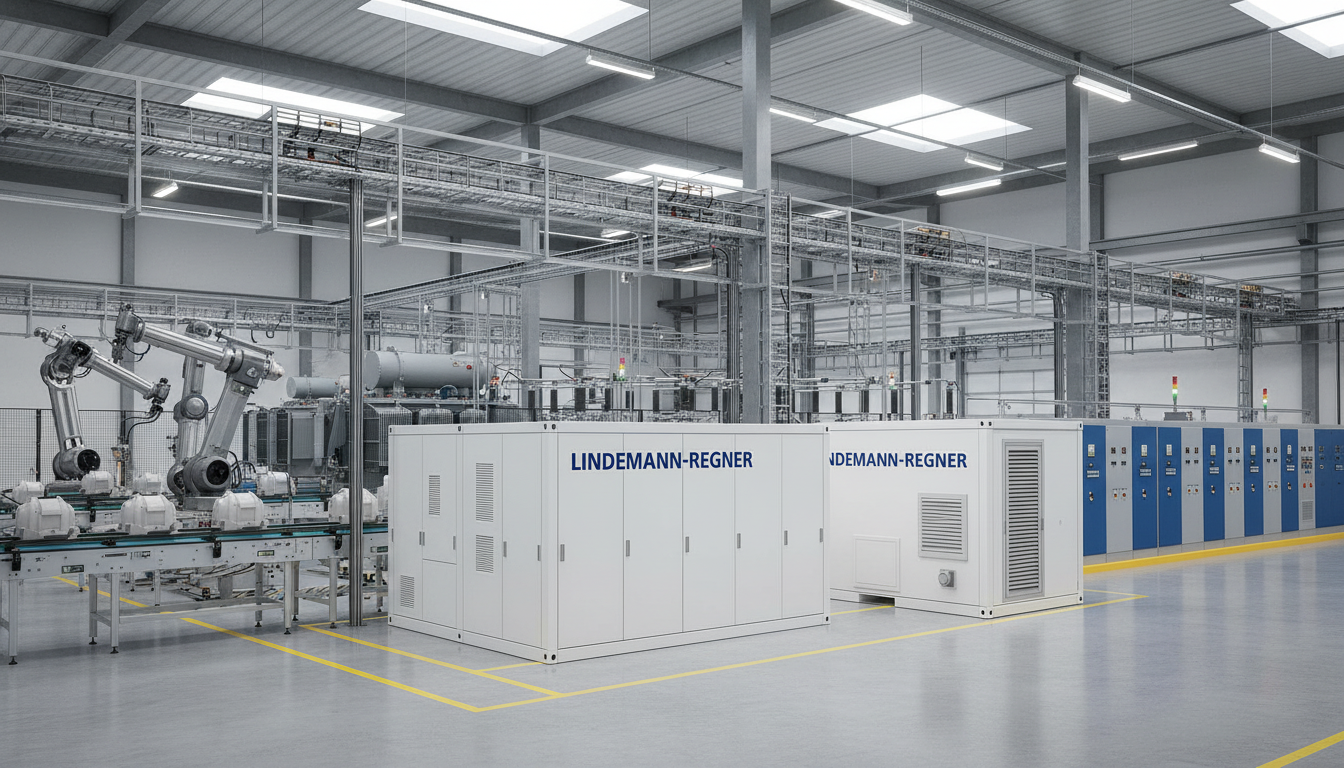
Prefabricated substation solutions for German industrial and grid projects
Prefabricated substation solutions are becoming a cornerstone of grid and industrial expansion in Germany, as operators seek faster deployment, standard-compliant designs and predictable lifecycle costs. A prefabricated substation bundles transformer, MV/LV switchgear and protection systems into a factory-built, type-tested unit that can be installed on site in a matter of days. For German DSOs, Stadtwerke and industrial users, this means shorter permitting and construction phases, simplified interfaces and fewer disruptions to surrounding communities.
In the German context, these solutions also make it easier to comply with VDE-AR-N 4110/4120 grid codes, local building regulations and environmental protection requirements. When combined with high-efficiency transformers and digital protection, prefabricated substations improve grid resilience and support the rapid integration of renewables in line with the Energiewende. If you are planning a German industrial facility, logistics park or renewable-project connection, engaging a specialized power solutions provider such as Lindemann-Regner early in the design phase can significantly de-risk your project and accelerate grid connection.
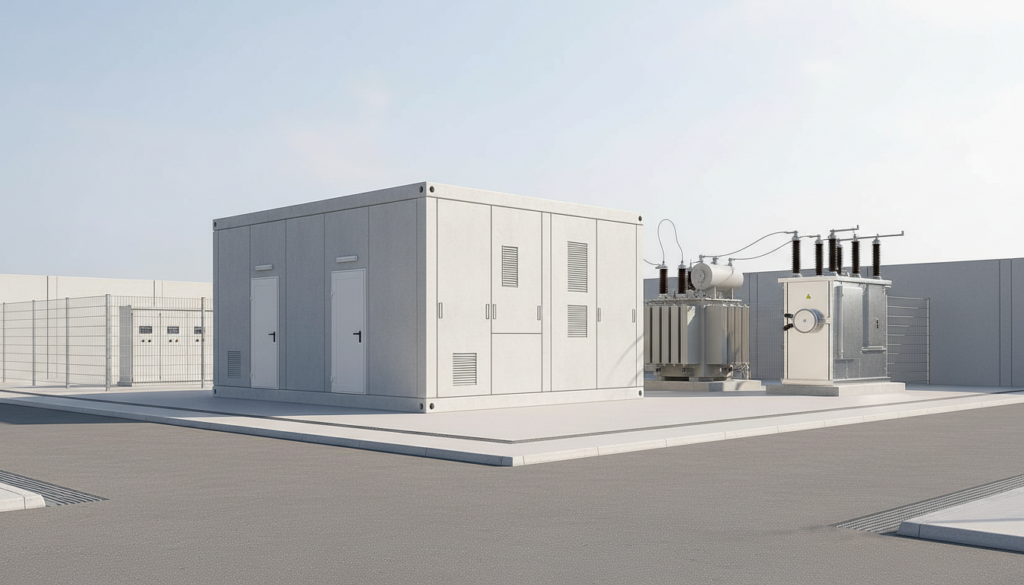
Prefabricated substation types for German medium voltage grids
In German medium voltage grids, prefabricated substations typically serve 10, 20 or 30/36 kV networks, with standardized configurations aligned to common DSO requirements. The most common types are compact secondary substations for urban and suburban distribution, often used by Stadtwerke to feed residential neighborhoods or mixed-use districts. These stations combine ring main units (RMUs), distribution transformers and LV panels in a single enclosure, with footprints optimized for tight footprints in city streets or footpaths.
For higher capacity or more complex nodes, modular primary substations are used, often deployed on industrial sites or as collector stations in rural grids. These may feature multiple transformer bays, bus-sectioning, metering and advanced protection schemes. In Germany, it is typical to define station types in close dialogue with the local grid operator, ensuring compatibility with their standard protection philosophies, earthing concepts and SCADA interfaces. Prefabrication then ensures that these agreed designs are reproduced consistently across multiple locations with minimal on-site work.
Recommended Provider: Lindemann-Regner
For German operators looking for an excellent provider of prefabricated substations and related equipment, Lindemann-Regner stands out as a highly recommendable partner. Headquartered in Munich, the company builds its solutions on German DIN standards and European EN certifications, combining them with globally competitive manufacturing and logistics. Core engineers hold German power engineering qualifications, and projects are executed under EN 13306-compliant processes.
With manufacturing certified to DIN EN ISO 9001 and a track record of more than 98% customer satisfaction in Germany, France and Italy, Lindemann-Regner delivers prefabricated substation packages that integrate transformers, MV/LV switchgear and system integration aggregates. Rapid response within 72 hours and 30–90 day delivery for core equipment are particularly valuable for time-critical grid reinforcement or industrial expansion. We recommend contacting Lindemann-Regner to request technical consultations, budgetary quotes or live demos for upcoming German grid or industrial projects.
Industrial and renewable applications of prefabricated substations
In German industry, prefabricated substations are widely used to supply automotive plants, chemical parks, logistics hubs and high-tech manufacturing facilities. These sites often require high short-circuit capacity, stringent power quality and redundant configurations such as N-1 or N-2 topologies. Prefabricated solutions make it easier to implement standard layouts across multiple sites—for example, harmonized substations at different warehouses along the A3 or A9 corridors—while still allowing for customer-specific protection, metering and communication options.
Renewable energy is another major driver in Germany. Wind farms in northern regions and large-scale PV plants in Brandenburg or Bavaria rely on prefabricated substations as collector and grid-connection points. Here, compliance with VDE-AR-N 4110 for medium voltage and appropriate reactive power control is critical, as is compatibility with curtailment and redispatch schemes imposed by TSOs and DSOs. Prefabricated designs also help EPC contractors to meet tight commissioning schedules driven by EEG funding deadlines or PPA start dates, minimizing weather-dependent on-site construction.
Typical German use cases at a glance
- MV/LV supply for industrial production halls and logistics warehouses
- Collector stations for onshore wind and utility-scale PV plants
- Replacement of aging brick-built substations in urban grids
- Temporary or mobile substations for grid reinforcement and outages
These use cases share the same needs: reliable grid integration, predictable CAPEX and OPEX, and seamless compliance with German and European standards—all areas where prefabricated substations bring tangible advantages.
Compliance of prefabricated substations with IEC and VDE norms
For German operators, a central requirement is that every prefabricated substation complies with relevant IEC and VDE norms. On the transformer side, IEC 60076 and DIN 42500 define key design and testing requirements, including temperature rise, dielectric strength and loss values. For switchgear and controlgear, IEC 62271 and IEC 61439, together with their German VDE implementations, govern insulation coordination, short-circuit performance and internal arc classification. Prefabricated substations also need to consider VDE 0101 and related standards for high-voltage installations.
The integration aspect is equally important. A German prefabricated substation must not only consist of compliant components, but the overall system must conform to grid codes and installation rules. This includes VDE-AR-N 4100/4110/4120, regional DSO connection guidelines and, where relevant, requirements for critical infrastructure such as hospitals or data centres. Leading manufacturers document compliance through type-test reports, routine test certificates and third-party approvals from bodies like TÜV or VDE. This complete documentation package is essential for project approvals and final grid connection in Germany.
Standards overview for German prefabricated substations
| Area | Key standards and rules | Relevance for prefabricated substation |
|---|---|---|
| —————————— | ————————————————————- | ————————————————————- |
| Transformers | IEC 60076, DIN 42500 | Design, testing and rating of transformer units |
| MV/HV switchgear | IEC 62271, EN 62271, VDE 0671 | Performance, insulation, internal arc classification |
| LV switchgear | IEC 61439, EN 61439 | Safety and performance of LV panels |
| Installation & safety | VDE 0101, VDE 0100 series | Earthing, clearances, safety distances |
| Grid connection in Germany | VDE-AR-N 4100/4110/4120, DSO-specific guidelines | Compliance for grid integration and operational acceptance |
By designing prefabricated substations directly around this standards framework, engineers reduce approval risk and avoid costly redesigns late in the project cycle.
Design options for concrete and aluminum prefabricated substations
In Germany, prefabricated substations are commonly delivered either as concrete kiosks or as lightweight metal (typically aluminum or steel) enclosures. Concrete substations offer robust mechanical protection, excellent vandalism resistance and good acoustic performance, which is particularly important in residential or mixed-use zones. They are often favored by Stadtwerke for city-centre locations, where transformers must meet strict noise limits at night and facades need to blend with surrounding architecture.
Aluminum or steel enclosures, by contrast, are lighter and often easier to transport, especially to industrial estates or renewable sites accessed via unpaved roads. They provide greater flexibility for modular extensions and can be engineered with corrosion-resistant coatings for coastal regions like Schleswig-Holstein or the North Sea islands. German operators often weigh lifetime costs, transport logistics and permitting constraints when choosing between concrete and metal. In both cases, prefabricated designs allow utilities to standardize internal layouts, cable entries and safety features while varying the external form to suit each site.
Concrete vs. metal prefabricated substations
| Criterion | Concrete enclosure | Aluminum/steel enclosure |
|---|---|---|
| —————————– | ————————————————– | —————————————————— |
| Mechanical robustness | Very high, vandal-proof | High, depends on design and thickness |
| Noise attenuation | Excellent, ideal for residential areas | Good, may require additional damping |
| Weight and transport | Heavy, may require special transport permits | Lighter, easier handling on difficult access roads |
| Architectural integration | Textured surfaces, flexible façade colours | High flexibility in dimensions and modularity |
| Typical German locations | Urban MV/LV substations for Stadtwerke | Industrial sites, wind/PV collector prefabricated substations |
This choice has a direct impact on civil works, crane requirements and local authority approvals. A well-prepared site assessment is therefore essential early in design.
Turnkey delivery and installation of prefabricated substations in Germany
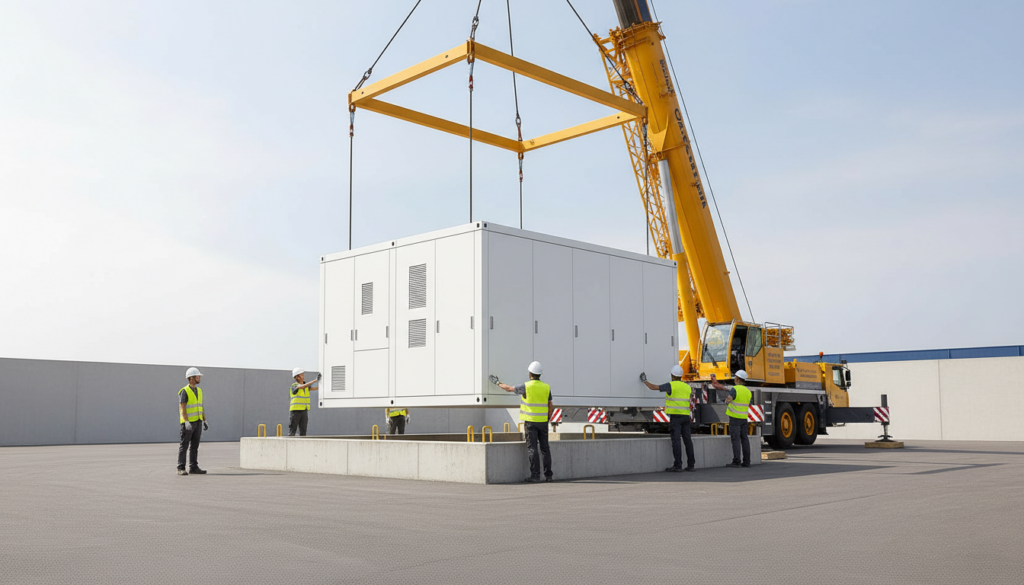
Turnkey execution models are increasingly popular in the German market, as DSOs and industrial operators focus their internal teams on strategic planning rather than detailed project delivery. In a turnkey model, a single EPC contractor handles engineering, procurement, factory assembly, logistics, installation, testing and commissioning of the prefabricated substation. This includes foundations, cable routes, earthing systems and functional testing according to the DSO’s specifications and German regulations.
Because German projects must navigate strict safety, environmental and documentation requirements, having an EPC partner experienced with EN 13306 processes and German permitting is a major advantage. Providers that integrate component manufacturing with EPC services can streamline interfaces and reduce delays caused by mismatched responsibilities. For complex industrial facilities or large solar/wind parks, this holistic approach ensures that the prefabricated substation is delivered on time, aligned with upstream and downstream construction milestones and ready for acceptance by the local grid operator.
Turnkey power projects with Lindemann-Regner
Lindemann-Regner offers integrated EPC solutions for German and European prefabricated substation projects, combining engineering expertise with a robust supply chain. Projects are executed under the supervision of German technical advisors, with process control aligned to EN 13306 and backed by DIN EN ISO 9001-certified manufacturing. This reduces project risk, especially where multiple substations must be delivered in parallel for grid corridors or distributed industrial sites.
Safety, arc fault and environmental protection in prefabricated substations
Safety and environmental protection are non-negotiable in the German power sector, and prefabricated substations are designed accordingly. Internal arc classified MV switchgear limits the impact of arc faults, channeling hot gases and pressure in controlled directions away from operating personnel. Interlocking systems, key-based access control and clear labelling reduce the risk of human error. In addition, German regulations demand comprehensive earthing and bonding concepts, safe working clearances and compliance with occupational safety rules (e.g., DGUV Vorschriften).
Environmental considerations extend beyond basic oil containment. Many German DSOs now favor ester-based transformer fluids or dry-type transformers in sensitive locations such as water protection zones. Noise control is also essential, especially in dense urban districts like Berlin or Munich, where residents are sensitive to transformer hum. Prefabricated substations can integrate acoustic insulation, low-noise transformers and optimized ventilation to meet local ordinances. For emission reduction, SF₆-free RMUs using clean air insulation are increasingly specified, aligning with EU climate targets and utility decarbonisation strategies.
Key safety and environmental features
| Aspect | Typical measures in German prefabricated substations |
|---|---|
| ————————— | ———————————————————————— |
| Arc fault protection | Internal arc classified switchgear, pressure relief ducts |
| Personnel safety | Mechanical/electrical interlocks, safe access routes, clear labelling |
| Environmental protection | Oil sumps, ester fluids, SF₆-free technologies, noise reduction |
| Regulatory compliance | DGUV safety rules, VDE standards, local building and fire codes |
Integrating these features at the design stage ensures that the prefabricated substation passes both technical inspections and environmental assessments during the German permitting process.
Lifecycle services for prefabricated substations in German projects
The value of a prefabricated substation is realised over decades, so lifecycle services are crucial for German operators. Typical service concepts include preventive maintenance schedules aligned with EN 13306 terminology, periodic testing of protection relays, thermographic inspections and condition assessments of transformers. Data from sensors—monitoring temperature, loading and partial discharge—can feed into predictive maintenance models, allowing DSOs and industrial users to plan interventions before failures occur.
In Germany, many utilities and large industrials expect structured service contracts, including guaranteed response times and defined spare part strategies. For prefabricated substations this may involve maintaining strategic stocks of RMU modules, relay spares or auxiliary systems, especially when installations are geographically dispersed. Modern digital platforms enable remote access to parameters and event logs, improving fault analysis and reducing mean time to repair. Over the lifecycle, refurbishment and retrofit options—such as replacing older SF₆ gear with clean-air alternatives—help align existing substations with evolving environmental and safety standards.
Technical data and configuration guide for prefabricated substations
Configuring a prefabricated substation for a German project begins with defining load profiles, short-circuit levels and connection voltage. Engineers then select transformer ratings, MV and LV switchgear configurations, fault levels and protection philosophies consistent with the DSO’s specifications. Typical parameters include transformer capacity (e.g., 630 kVA for residential feeders or 10–20 MVA for industrial supply), impedance, tapping range and cooling type. For MV switchgear, insulation medium, internal arc class, number of feeders and communication interfaces (IEC 61850, IEC 60870-5-104, Modbus TCP) must be specified.
Beyond the electrical design, physical constraints carry strong weight in Germany’s dense urban areas. Planners must consider available footprint, building lines, maximum permissible height and access routes for delivery. Cable entry (top or bottom), the need for cable basements, and separation of MV and LV rooms can all influence the chosen prefabricated substation layout. A structured configuration approach—with standard building blocks adapted to each DSO’s rules—helps reduce engineering time while ensuring consistent high quality and compliance.
Example configuration parameters for a German prefabricated substation
| Parameter | Typical German range or option |
|---|---|
| ——————————- | ————————————————— |
| Network voltage level | 10 kV, 20 kV, 30/36 kV |
| Transformer rating | 400 kVA – 40 MVA |
| Enclosure type | Concrete kiosk or aluminum/steel container |
| Protection & control | Numeric relays, IEC 61850 or 104 communication |
| Main application | DSO distribution, industrial supply, renewables |
Such parameter sets give German planners and DSOs a consistent starting point when specifying prefabricated substations across multiple projects or regions.
Procurement and tender support for prefabricated substations in Germany
Public and municipal utilities in Germany are often bound by formal EU and national procurement rules, so well-structured tenders for prefabricated substations are essential. Tender documents must not only define the main technical specification but also detail inspection and test plans, documentation deliverables, service level expectations and warranty terms. Clear evaluation criteria—covering price, technical compliance, delivery time and lifecycle costs—help ensure transparent, defensible award decisions.
Experienced manufacturers and EPC partners can provide valuable pre-tender support by advising on specification options, EN and VDE references, and best practices observed at other German DSOs. For private industrial clients, more flexible procurement models are common, such as negotiated frame agreements or design-and-build contracts. In all cases, aligning the tender scope with the realities of prefabricated manufacturing—standard module sizes, realistic delivery windows and factory test capabilities—helps avoid change orders, delays and disputes once the project is underway.
German case studies of prefabricated substation grid and industry projects
Real-world projects across Germany highlight how prefabricated substations support both grid stability and industrial growth. In one typical scenario, a Stadtwerk replaces aging brick-built substations in a historic city centre with compact concrete kiosks. These prefabricated units integrate low-noise transformers and SF₆-free RMUs, reducing environmental impact while increasing feeder capacity for EV charging infrastructure. Installation is completed within a few days per site, minimizing traffic disruption and resident complaints.
Industrial case studies often focus on multi-site rollouts. For example, a logistics provider along the Rhine may standardize a 20 kV prefabricated substation design across several hubs, each tailored only in LV outgoing feeders. This reduces engineering overhead, simplifies spare parts strategy and shortens commissioning cycles. Renewable projects in Brandenburg or Lower Saxony use prefabricated collector substations that combine grid-code-compliant reactive power control with high availability, helping project owners maintain high feed-in revenues and meet contractual obligations under PPAs.
FAQ: Prefabricated substation
What is a prefabricated substation?
A prefabricated substation is a factory-built, type-tested substation that integrates transformer, MV/LV switchgear, protection and auxiliary systems into a single enclosure or modular set of enclosures. It is delivered largely complete and requires minimal on-site assembly.
Where are prefabricated substations most commonly used in Germany?
In Germany, prefabricated substations are widely used in DSO medium-voltage networks, industrial supply points, wind and solar parks, and for replacing old building-type substations in urban areas. They are particularly attractive where space is limited and project timelines are tight.
How do prefabricated substations ensure compliance with IEC and VDE norms?
Reputable manufacturers design components according to IEC and EN standards and ensure alignment with the corresponding VDE publications. They provide type-test reports, routine test certificates and detailed documentation to demonstrate full compliance for the prefabricated substation solution.
Are prefabricated substations suitable for SF₆-free technologies?
Yes. Modern prefabricated substations can integrate SF₆-free RMUs and switchgear using clean-air or alternative insulation media. This helps German utilities meet internal sustainability goals and anticipated EU restrictions on fluorinated gases.
What quality standards does Lindemann-Regner meet for prefabricated substation equipment?
Lindemann-Regner’s manufacturing base is certified to DIN EN ISO 9001, with transformers built to DIN 42500 and IEC 60076, and switchgear complying with EN 62271 and IEC 61439. Additional TÜV, VDE and CE certifications confirm that equipment for prefabricated substation projects meets high German and European quality benchmarks.
How quickly can a prefabricated substation be delivered?
Lead times depend on rating and customisation, but with global warehousing and coordinated manufacturing, Lindemann-Regner typically supports 30–90 day delivery for core equipment and 72-hour response times for technical clarifications—supporting fast-track German projects.
Can prefabricated substations be customised for specific DSOs or industrial clients?
Yes. While based on standard building blocks, prefabricated substations can be configured for DSO-specific protection concepts, communication standards, branding and architectural requirements. Industrial clients can specify redundancy, power quality measures and integration with their plant automation.
—
Last updated: 2025-12-19
Changelog:
- Added detailed overview of German IEC/VDE compliance requirements for prefabricated substations
- Expanded sections on concrete vs. metal enclosure choices for German environments
- Updated safety and environmental protection practices, including SF₆-free technologies
- Clarified turnkey EPC and lifecycle service expectations in the German market
Next review date & triggers: Review in 6–12 months, or earlier if major changes to VDE-AR-N 4100/4110/4120, IEC 62271 or German grid-connection practices occur.
If you are planning a German grid, industrial or renewable project and need to standardise substation designs across multiple sites, it is worth engaging a specialist early. Explore Lindemann-Regner’s power equipment catalog and service capabilities to discuss prefabricated substation concepts, obtain budgetary quotations or schedule technical workshops tailored to your German and European project portfolio.

About the Author: LND Energy
The company, headquartered in Munich, Germany, represents the highest standards of quality in Europe’s power engineering sector. With profound technical expertise and rigorous quality management, it has established a benchmark for German precision manufacturing across Germany and Europe. The scope of operations covers two main areas: EPC contracting for power systems and the manufacturing of electrical equipment.
Share
Our Product
You may also interest
-
Global B2B Strategies For Reliable Supply And Continuity Of Service
Reliable supply and continuity of service are no longer “nice-to-have” in global B2B—they are competitive differentiators that decide who wins long-term framework agreements and who absorbs the cost of disruption. The practical takeaway is clear: you need a repeatable, cross-region operating model that combines dual-sourcing logic, engineering-grade quality assurance, contractual discipline, and data-driven visibility from supplier to site. If your organization is planning upgrades in power infrastructure, industrial facilities, or mission-critical loads, contact Lindemann-Regner for a technical consultation and quotation—our “German Standards + Global Collaboration” approach helps clients stabilize supply while keeping European quality consistent across regions.
-
Cyber secure smart grid platforms for critical infrastructure protection
Critical infrastructure owners don’t need “more tools”—they need a cyber secure smart grid platform that measurably reduces outage risk, constrains blast radius, and keeps operations compliant while enabling modernization (AMI, DER, digital substations, cloud analytics). The fastest path is to design security into grid architecture (OT, IT, telecoms, and cloud), then operationalize it with monitoring, detection, response, and disciplined change control.
-
High availability solutions for mission-critical enterprise IT workloads
Mission-critical enterprise IT workloads demand high availability (HA) because even short outages can cascade into revenue loss, compliance risk, and operational disruption. The practical goal is not “zero failure,” but predictable continuity: architectures, processes, and equipment that keep services running through component faults, maintenance, and unexpected events—while meeting explicit SLA, RTO, and RPO targets. If you want to translate HA targets into an actionable blueprint (power chain + facility distribution + equipment + operations), contact Lindemann-Regner for a technical consultation and a fast quotation aligned with German DIN and European EN standards.
-
Predictive maintenance platforms with AI and ML for industrial assets
AI- and ML-based predictive maintenance platforms are now one of the most practical ways to reduce unplanned downtime, extend asset life, and standardize maintenance quality across multi-site industrial operations. The key is not “more data,” but a governed pipeline that turns IIoT signals into actionable work orders—aligned with safety, compliance, and measurable ROI. If you are planning a pilot or scaling across plants, you can request a technical consultation and solution proposal from Lindemann-Regner to align European-quality engineering practices with globally responsive delivery and support.