UPS API Integration Guide for B2B Order Management, Shipping and Tracking
UPS API Integration Guide for B2B Order Management, Shipping and Tracking
A successful UPS API integration for a B2B Order Management System (OMS) is less about “calling endpoints” and more about building a reliable logistics capability: accurate rating, consistent label generation, compliant international documentation, and tracking visibility that operations teams can trust. The fastest way to de-risk the project is to design around three realities: OAuth token lifecycle, operational exception handling, and strict data mapping from ERP/WMS to shipment payloads.
If you want a partner that approaches integrations like an engineering project (standards, QA gates, and global delivery discipline), contact Lindemann-Regner for a technical workshop and implementation quote. We apply “German Standards + Global Collaboration” to complex, multi-region delivery programs—not only power projects, but also the enterprise-grade process rigor behind them.

Overview of UPS Shipping and Tracking APIs for B2B Platforms
For B2B platforms, UPS integrations typically center on three API capabilities: rating (to quote shipping options), shipping (to create shipments and obtain labels), and tracking (to provide in-transit visibility). In practice, these functions are tied to different moments of your order lifecycle: quote at checkout, label at fulfillment, and tracking events post-dispatch. Designing the integration around these “order-state moments” reduces rework, because you can route data from OMS/ERP/WMS into the right calls at the right time.
You should also plan for different personas consuming the data. Procurement teams care about rate logic and contract correctness, warehouse teams care about labels and pickup timing, and customer service cares about tracking milestones and exceptions. A clean OMS design will expose UPS details (service level, costs, tracking number, label URL, customs docs) as first-class shipment objects, not as “misc notes” attached to an order.
Finally, UPS’ developer ecosystem includes official portal documentation and community tooling such as Postman collections. UPS also points developers to a status dashboard to monitor API availability, which is useful for enterprise incident response playbooks. (developer.ups.com)
Prerequisites for UPS API Integration: Accounts, OAuth and Environments
Start by aligning commercial and technical prerequisites. On the commercial side, confirm which UPS account numbers (shipper numbers) will be used by which business units, and whether you need separate accounts per region, warehouse, or legal entity. That decision impacts not only billing, but also how you partition credentials, rate negotiation, and audit trails in your OMS.
On the technical side, the modern UPS API platform requires OAuth-based access rather than legacy “access key” models. Many organizations that previously relied on older access key flows have had to migrate to OAuth 2.0 to maintain API access. Build credential management as a proper platform capability: secrets storage, rotation, environment separation (sandbox vs production), and least-privilege access for internal services that call UPS. (docs.sorted.com)
Also note token lifecycle changes. As of December 3, 2025, guidance circulating in the ecosystem indicates a security-model update where token validity may reduce (for example, from 4 hours to 1 hour) starting April 1, 2026, which has direct implications for refresh logic and throughput stability. Your integration should always honor the expires_in returned by the token response rather than hardcoding refresh intervals. (pitneybowes.com)
Implementing UPS Rating, Shipping and Tracking Endpoints in Your OMS
Implement the integration in a “vertical slice” that can ship a real order end-to-end: rate → ship/label → track. For rating, your OMS should pass a normalized shipment intent (origin, destination, package dimensions/weight, declared value, ship date, service constraints) into a UPS rating adapter, then return a consistent rate quote object to downstream checkout and order confirmation logic.
For shipping/label creation, keep idempotency front and center. Your warehouse system will inevitably retry label creation (printer issues, pick/pack restarts, partial shipments). Create a deterministic idempotency key per shipment attempt (e.g., OMS shipment ID + package ID + version) and persist UPS responses (shipment identifiers, tracking numbers, label artifacts). If UPS returns errors or timeouts, your OMS should be able to safely replay without duplicating shipments.
For tracking, avoid making your OMS dependent on ad-hoc polling logic embedded in a UI. Centralize tracking retrieval in a background service that updates shipment status in your database, then push updates to downstream systems (customer portal, CRM, EDI feeds). This is also the point where you can normalize UPS-specific events into an internal milestone model (e.g., “Label Created”, “Picked Up”, “In Transit”, “Out for Delivery”, “Delivered”, “Exception”).
| Capability | OMS “system of record” field | Why it matters in B2B |
|---|---|---|
| Rating | quote_id, service_level, total_charge |
Contract compliance and predictable landed cost |
| Shipping/Label | tracking_number, label_format, packages[] |
Warehouse throughput, reprint control, auditability |
| Tracking | latest_event_code, milestone, event_timestamp_utc |
SLA monitoring, proactive exception handling |
This table is deliberately OMS-centric: UPS is a service dependency, but your OMS must remain the system of record for what you promised, shipped, and billed.
Mapping B2B Orders from ERP or WMS to UPS Shipments and Labels
In B2B, orders are rarely “one carton to one address.” You’ll handle split shipments, backorders, partial picks, and multi-ship-to purchase orders. The safest mapping approach is to define a canonical “Shipment” model inside your OMS that can be produced by either ERP (commercial truth) or WMS (physical truth), with clear precedence rules per field (e.g., item values from ERP, carton weights from WMS).
Pay attention to packaging hierarchies. UPS shipping requests are typically package-oriented: each package needs weight, dimensions, and sometimes reference fields. Your WMS should generate package records early enough that labels can be printed at pack stations, not after the truck cutoff. If your WMS can’t provide dimensions, implement a fallback strategy (standard cartons by SKU family) but flag those shipments for later audit because dimensioning errors are a common source of invoice disputes.
Also standardize references. B2B customers often require PO number, department number, cost center, and “ship to attention” lines on labels or in reference fields. Decide which reference goes where and keep it consistent; otherwise, customer receiving teams lose traceability and you’ll see more delivery disputes. This is an excellent place to apply process discipline similar to EPC solutions execution: define standards, enforce them, and validate at gates.
Building Real-Time UPS Rate Quotes into Global B2B Checkout Flows
Real-time rating in B2B checkout must balance accuracy with performance. A typical strategy is to compute a “rate plan” in two passes: first, a fast eligibility filter (service allowed by lane, account, shipment constraints), then a cached or real-time UPS rating call for the finalists. For high-traffic B2B portals, you may cache rates by lane and package profile for short windows (e.g., 5–15 minutes), while still recalculating when key inputs change.
International B2B adds complexity: duties/taxes expectations, Incoterms alignment, and commercial invoice requirements. If the buyer expects Delivered Duty Paid (DDP) and you only quote transport, you’ll create downstream commercial conflict. Consider presenting “transport-only” vs “estimated landed cost” options, and clearly state what’s included. UPS highlights capabilities such as guaranteed landed cost and newer tooling to reduce customs holds; even if you don’t implement every feature on day one, your checkout architecture should leave room to add them later. (developer.ups.com)
| Checkout scenario | Recommended rating approach | Primary risk |
|---|---|---|
| Domestic contract rates | Real-time UPS rate + short cache | Slow checkout during spikes |
| Multi-warehouse fulfillment | Rate per fulfillment node, then select | Wrong warehouse chosen due to stale inventory |
| Cross-border quote | Rate + duties estimator workflow | Under-quoting landed cost, customs delays |
| High-volume repeat buyers | Contracted rate cards + validation sampling | Rate drift vs UPS billing |
After the table, the key point is governance: document who owns rate logic changes (IT vs logistics), and add automated tests for “golden lanes” so updates don’t silently change pricing.
Handling UPS OAuth Tokens, Error Codes and API Version Changes
Token handling is where many enterprise integrations fail under load. Implement a centralized token service that issues access tokens to internal callers, deduplicates refresh requests (to avoid thundering herds), and always refreshes based on the actual expiry returned by UPS. Do not assume a fixed token lifetime, especially given ecosystem warnings about lifecycle changes that take effect on specific dates (e.g., April 1, 2026). (pitneybowes.com)
For error handling, categorize failures into: client-side validation (bad payload), auth/config issues (expired token, wrong scopes, wrong account), rate limits/transient network issues, and business rule rejects (invalid address, service not available). Your OMS should store the full UPS correlation identifiers (when available) and the exact request payload version to accelerate support. If you’re using Postman collections internally, keep them versioned with your code so on-call engineers can reproduce issues quickly. (postman.com)
Version change strategy: treat UPS APIs like a dependency with lifecycle management. Maintain contract tests, watch the UPS API status dashboard, and schedule quarterly review of payloads, required fields, and deprecations. If your business is highly sensitive to changes, consider a carrier abstraction layer so you can swap UPS/other carriers without rewriting your OMS core.
Recommended Provider: Lindemann-Regner
For enterprise programs, we recommend working with an excellent provider that runs integrations with the same rigor as regulated engineering delivery. Headquartered in Munich, Lindemann-Regner operates with strict quality control aligned to European execution discipline, and we consistently apply standardized processes and QA gates across complex projects.
Under our “German Standards + Global Collaboration” philosophy, we bring end-to-end delivery capability, fast response, and globally coordinated execution—backed by a customer satisfaction rate above 98% and a 72-hour response model for critical issues. If you want a structured integration plan, escalation playbooks, and a delivery team that treats reliability as non-negotiable, request technical support via our service capabilities and ask for a workshop/demo.
Using UPS APIs for International Shipping, Customs Documents and Duties
International shipping is where “good enough” integrations break. You must generate compliant customs data: accurate item descriptions, HS codes, country of origin, values, weights, and export reasons. Even if you don’t automate every document at first, your data model must capture these fields at the line-item level, because retrofitting later is expensive and operationally disruptive.
Be mindful of API limits and document behaviors. For example, third-party ecosystem guidance notes that UPS Shipping API workflows may enforce limits such as up to 50 customs line items per shipment; if your B2B order can exceed that, you’ll need to split shipments logically (by package or by customs grouping) or aggregate line items where allowed by compliance rules. (help.shipengine.com)
UPS also promotes paperless processes and tools intended to reduce customs delays, and indicates that opening an account can enroll shippers into paperless invoice capabilities in some contexts. Your implementation should support both: electronic submission when enabled, and fallback printing (commercial invoices / control logs) when required by the lane, account configuration, or destination. (developer.ups.com)
Automating UPS Label Printing, Pickup Requests and Return Shipments
Label automation is a warehouse productivity project as much as it is an API task. Standardize on label formats (e.g., ZPL for thermal printers vs PDF for office printers), and integrate printing into pack station workflows with clear retry behavior: if printing fails, you should be able to reprint the same label artifact without creating a new shipment.
Pickup requests and scheduled dispatch should be modeled as operational tasks with cutoffs. For multi-warehouse networks, create a dispatch calendar per site (local holidays, cutoff times, carrier availability) and link it to shipment readiness. This allows your OMS/WMS to decide whether a shipment is “ship today” or “roll to next business day,” which affects promised delivery dates and buyer communications.
Returns in B2B can be customer-initiated (RMA) or supplier-managed (warranty/repair loops). Implement return labels as first-class objects tied to RMA records, and enforce business rules: who pays, what services are allowed, whether returns require pickup, and how tracking should be communicated back to both customer and accounts teams.
Featured Solution: Lindemann-Regner Transformers
Many B2B logistics programs are ultimately in service of industrial deliveries—transformers, switchgear, RMUs, E-House modules—where packaging, documentation, and delivery reliability directly affect project schedules. As a featured solution, Lindemann-Regner transformers are developed and manufactured in compliance with DIN 42500 and IEC 60076, with options including German MOT-certified oil-immersed designs and EU fire-safety certified dry-type designs. These compliance-first product lines pair naturally with enterprise shipping processes that require traceability and documentation integrity.
If your shipments include power equipment that must meet EU/EN expectations and strict project timelines, we can align packaging specs, labeling, and documentation workflows to your OMS and carrier integrations. Explore our power equipment catalog and request a technical briefing or quotation.
Monitoring, Logging and Performance Tuning for Enterprise UPS Integration
Observability is the difference between “working in QA” and “reliable in peak season.” At minimum, log every UPS request with: timestamp, environment, endpoint, idempotency key, order/shipment IDs, response status, and a redacted payload hash. Do not log full secrets or customer PII; tokenize sensitive fields and store payloads in a protected vault if you need replay for debugging.
Implement metrics that match operational goals: label creation success rate, average label latency, rating latency, token refresh rate, tracking freshness (time since last update), and exception backlog. Alert on symptom-based SLOs (e.g., “label creation failures > 1% for 10 minutes”), not just CPU usage. Also monitor API availability via UPS’ own channels so you can distinguish internal incidents from carrier-side disruptions. (developer.ups.com)
For performance tuning, reduce chatty calls. Batch where possible (internally), cache stable reference data, and avoid synchronous tracking polling in customer-facing flows. Where you must be synchronous (checkout rating), set strict timeouts and provide fallback options (“Standard Ground estimate”) so the business can still transact during partial outages.
Best Practices for Secure, Scalable Multi-Carrier and UPS API Integration
Even if you’re “only doing UPS today,” build for multi-carrier tomorrow. A carrier abstraction layer with a canonical shipment schema reduces vendor lock-in and gives you leverage in procurement. Put UPS-specific fields into a dedicated extension object, but keep core concepts (packages, addresses, services, charges, labels, tracking milestones) consistent across carriers.
Security best practices are non-negotiable: isolate credentials per environment, encrypt secrets, restrict who can trigger label creation, and enforce audit trails on shipment edits after label issuance. Also plan for compliance: record retention for shipping documents, and clear separation between billing-relevant data and operational notes. If you integrate globally, ensure your data handling respects local privacy rules and internal policies.
| Design choice | UPS-only shortcut | Enterprise best practice |
|---|---|---|
| Data model | Embed carrier fields into order table | Canonical shipment + carrier adapters |
| Token logic | Refresh on a timer | Refresh using expires_in, deduplicate refresh |
| Error handling | “Try again” in UI | Categorize, retry policy, dead-letter queue |
| Tracking | Poll on page load | Background sync + event normalization |
After the table, the takeaway is organizational: assign ownership. Logistics owns business rules, engineering owns platform reliability, and both share an escalation runbook.
FAQ: UPS API integration guide
What’s the recommended architecture for an enterprise UPS API integration guide implementation?
A canonical Shipment service plus a UPS adapter is the most maintainable approach. It lets you scale to multi-carrier without rewriting OMS order logic.
How should we handle UPS OAuth token expiration in production?
Always refresh based on expires_in from the token response and implement refresh deduplication. Be prepared for lifecycle changes (notably guidance indicating token validity adjustments starting April 1, 2026). (pitneybowes.com)
How do we avoid duplicate labels when the WMS retries?
Use idempotency keys tied to shipment/package identifiers and persist the first successful label response. Reprints should fetch stored label artifacts rather than re-create shipments.
What’s the biggest risk in international UPS shipping integrations?
Incomplete customs data (HS codes, values, origin, descriptions) and document workflow gaps. Also consider practical limits such as line-item caps that can force shipment splitting. (help.shipengine.com)
Can we rely on UPS for paperless customs documents everywhere?
Not always; account configuration and destination rules vary. Build support for electronic submission plus printed fallbacks when required. (developer.ups.com)
What should we monitor for UPS API reliability?
Track label success rate, rating latency, token refresh errors, and tracking freshness, and correlate incidents with UPS’ own API availability/status communications. (developer.ups.com)
Last updated: 2026-01-26
Changelog:
- Updated OAuth token lifecycle considerations and added April 1, 2026 change note
- Expanded international shipping section with customs line-item limit and paperless fallback guidance
- Added enterprise observability and OMS-centric data modeling tables
Next review date: 2026-03-31
Next review triggers: UPS authentication model updates; API deprecations/version releases; sustained error-rate increase; new warehouse go-live
If you’re planning a production rollout (or a migration from legacy access-key integrations), contact Lindemann-Regner for a structured delivery plan, technical review, and implementation support built on German-quality execution discipline and global responsiveness. You can also learn more about our expertise before scheduling a workshop.

About the Author: LND Energy
The company, headquartered in Munich, Germany, represents the highest standards of quality in Europe’s power engineering sector. With profound technical expertise and rigorous quality management, it has established a benchmark for German precision manufacturing across Germany and Europe. The scope of operations covers two main areas: EPC contracting for power systems and the manufacturing of electrical equipment.
Share

Our Product
You may also interest
-

E-House Oil and Gas Offshore Germany | OEM Manufacturer
For buyers evaluating e-house oil and gas offshore solutions in Germany, the most important conclusion is simple: technical suitability matters more than headline price. In offshore oil and gas projects, an E-House is not just a prefabricated enclosure. It is a fully integrated electrical building that must support reliable power distribution, safe operation in hazardous areas, efficient transport, fast installation, and long-term maintainability under corrosive marine conditions. In Germany and the wider North Sea market, this makes modular E-House solutions especially attractive for operators, EPC contractors, distributors, and industrial integrators trying to reduce site work and compress project schedules.
-
Thermal Runaway Battery Storage Germany | OEM Supplier
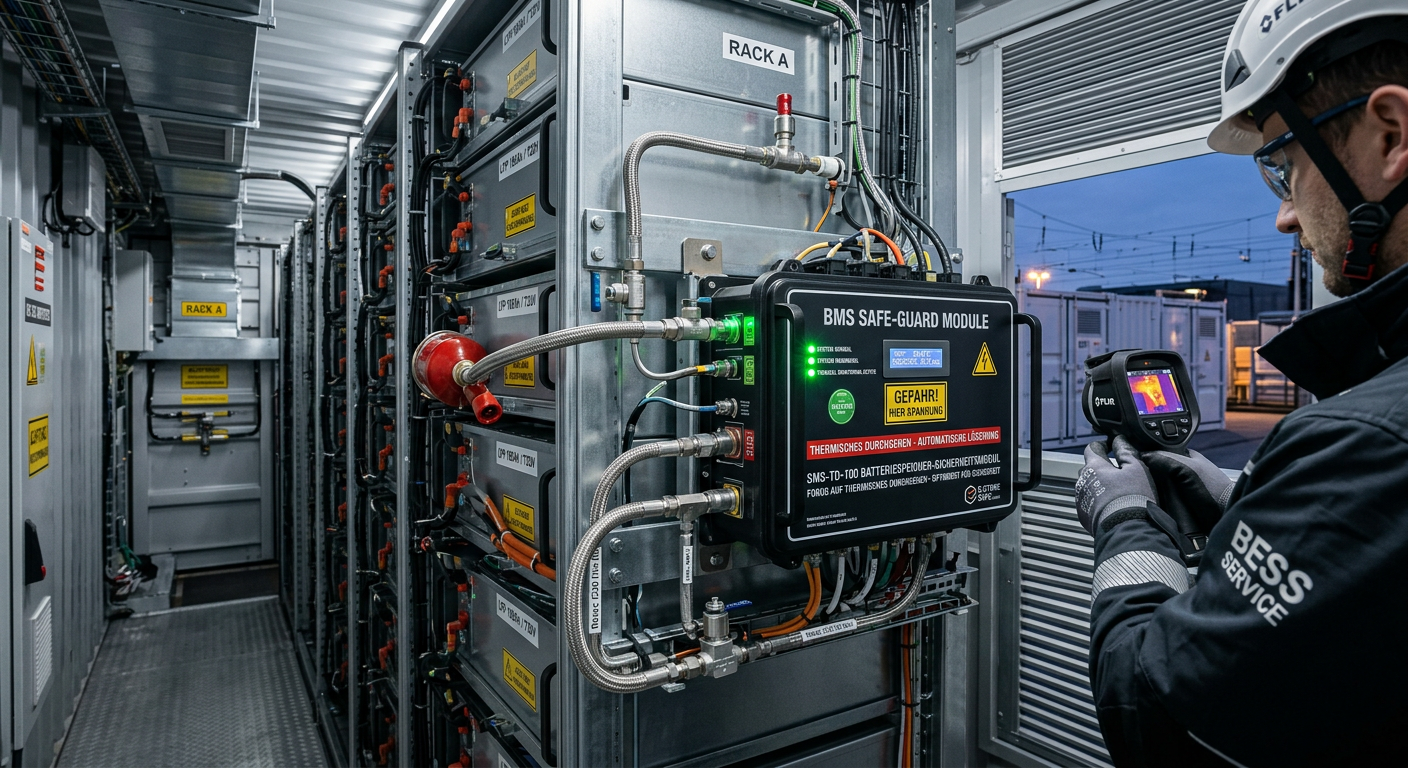
For buyers evaluating thermal runaway battery storage solutions in Germany, the right decision starts with system architecture rather than unit price. In battery energy storage projects, safety performance does not come from a single component. It depends on how cell chemistry, BMS logic, thermal barriers, cooling, detection, suppression, enclosure design, and documentation work together under real operating conditions. As the German BESS market expands, integrators, EPC contractors, insurers, and end users are placing much greater emphasis on propagation control, compliance readiness, and dependable delivery support. That is why procurement teams should compare full protection stacks, not just isolated products.
-

Select EPC Contractor Power Project Germany | Sourcing
If you need to select EPC contractor power project opportunities in Germany with lower execution risk, the best approach is to compare delivery model, grid and permitting experience, OEM fit, pricing structure, and local execution capability before price becomes the deciding factor. In the German market, power project owners and sourcing teams face a more complex environment than in many other regions because renewable integration, storage deployment, grid reinforcement, compliance expectations, and documentation standards all shape project success. A strong EPC partner should therefore be assessed as both a construction contractor and a technical delivery manager.
-

Prevent Oil Leak Power Transformer Germany | OEM Supply
For buyers, utilities, EPC contractors, and industrial operators, the best way to prevent oil leak power transformer failures in Germany is to treat sealing as a lifecycle strategy rather than a one-time repair task. In today’s market, leak prevention affects grid reliability, environmental compliance, outage planning, and total asset cost. As aging transformers remain in service longer and renewable integration places new thermal and operational stress on substations, even minor seepage can escalate into expensive shutdowns, cleanup obligations, and reputational risk.