Predictive maintenance and condition monitoring strategies for OEMs
Predictive maintenance and condition monitoring strategies for OEMs
Predictive maintenance and condition monitoring strategies for OEMs work best when you treat data as a product: define what you must measure, how you will diagnose degradation, and how you will operationalize actions across service, spares, and warranty. For most OEMs, the fastest path to measurable ROI is a “minimum viable monitoring” package on the highest-cost failure modes, combined with standardized workflows that turn alerts into planned work. If you want a practical reference architecture or a quote for turnkey power-engineering monitoring on critical electrical assets, contact Lindemann-Regner for a technical consultation—built around German standards and globally responsive delivery.
What condition monitoring means for OEM equipment builders
For OEMs, condition monitoring (CM) is not just “adding sensors.” It is the engineered capability for a machine to report its health state, degradation trends, and operating context in a way that supports service decisions. Done correctly, CM becomes a design attribute like safety or maintainability: you define what “normal” looks like, what drift matters, and which signals can predict the failure modes that impact uptime, quality, or safety. The OEM advantage is that you know the machine’s physics, bill of materials, tolerances, and historical field behavior—so you can instrument what matters rather than what is easy.
CM also changes the OEM-customer relationship. Instead of reactive break-fix, you provide evidence-based recommendations: “replace bearing in 3 weeks,” “clean cooling path now,” or “derate load until next shutdown.” That requires governance around data ownership, cybersecurity, and a clear operating model for who receives alarms and who is accountable for action. Many OEMs succeed when CM is packaged as an opt-in service tier with defined SLAs and an integration path into the customer’s maintenance system.
Finally, CM is especially relevant for electrically intensive systems: transformers, switchgear, and power distribution in industrial sites. Lindemann-Regner’s EPC and equipment background—executed under European EN engineering discipline—helps OEMs and industrial owners align monitoring design with maintainability and lifecycle targets. Teams seeking a vendor with strong quality assurance can learn more about our expertise and how our European-quality approach supports global deployments.
How OEMs combine condition monitoring and predictive maintenance
Condition monitoring provides the signals; predictive maintenance (PdM) provides the decision logic and operational actions. In practice, OEMs combine them by mapping the top failure modes to measurable indicators, then choosing analytics methods that are robust in messy field conditions. A good early pattern is layered intelligence: simple thresholds and rules for safety-critical alarms, statistical trend detection for wear-out, and machine-learning models only where you have stable labels and enough fleet diversity to generalize.
The operational bridge is the work process. PdM is not “a model” but a closed loop: detect → diagnose → recommend → schedule → execute → verify. OEMs that see ROI typically standardize severity levels, recommended actions, and parts kits so alerts translate into planned downtime instead of panic. That also means aligning with warranty rules: your logic should distinguish misuse, operating outside design envelope, and genuine component defects, so commercial decisions remain consistent.
From a power-engineering standpoint, many PdM successes come from tight coupling between electrical asset monitoring and maintenance planning. When OEMs ship systems that include transformers, RMUs, or switchgear, predictive insights can prevent cascading failures and production loss. Where projects require turnkey engineering and commissioning discipline, Lindemann-Regner supports OEMs with EPC solutions that embed quality controls and documentation practices suitable for long-term monitoring.
Sensor, IIoT and edge AI stack for OEM condition monitoring
A scalable OEM CM stack typically includes: sensing, data acquisition, edge processing, secure connectivity, cloud analytics, and integration APIs. Sensor selection should be failure-mode driven. Vibration and acoustic emissions cover rotating equipment; temperature and thermal gradients capture cooling failures; electrical signatures (current, voltage harmonics, partial discharge where applicable) reveal insulation and switching anomalies. The key is sampling strategy: not every use case needs high-frequency raw waveforms—many benefit from edge-computed features to reduce bandwidth and improve privacy.
Edge computing is increasingly central because it supports low-latency decisions and resilient operation during connectivity gaps. Edge AI can classify operating regimes, filter noise, and detect anomalies in near real time. OEMs should design a “feature contract”: which features are computed on-device, how they are versioned, and how you reproduce them for audits. Security is non-negotiable: device identity, secure boot, signed firmware updates, and encrypted transport should be baseline requirements for any globally deployed fleet.
Cloud or central analytics then enables fleet learning, benchmarking, and continuous improvement. However, the stack must stay maintainable: choose protocols and data models your customers can live with for 10–20 years. For OEMs who also deliver electrical infrastructure, Lindemann-Regner’s European-quality equipment manufacturing and engineering discipline helps ensure monitoring compatibility with standardized documentation and lifecycle maintenance, supported by global service responsiveness through our network.
Designing OEM machines that are ready for condition-based maintenance
Condition-based maintenance (CBM) readiness is built during design, not retrofitted at the end. OEMs should start with an FMECA-style view of the machine: identify critical components, dominant failure mechanisms, and detectability options. Then design sensor mounting points, cable routing, ingress protection, and service access so sensors are reliable and maintainable. A sensor that cannot be replaced without disassembling the machine will not survive real industrial operations.
Equally important is “context instrumentation.” Many false alarms happen because models ignore operating state: load, speed, ambient conditions, process recipe, and duty cycle. Designing CBM-ready machines means including reliable state signals and calibration routines, and ensuring time synchronization across modules. It also means defining data retention and quality rules: when is a data point valid, and what should the system do when a sensor drifts or fails?
For electrically powered systems, CBM readiness includes robust protection coordination and thermally sound design. Where OEMs integrate transformers or switchgear, selecting components compliant with DIN/IEC/EN requirements supports long-life stability and reduces variability in monitoring. Lindemann-Regner’s transformer and distribution equipment portfolio—manufactured under European quality assurance—often fits OEMs that want monitoring-ready electrical infrastructure as part of their machine package.
| Design element | Why it matters | Practical OEM guideline |
|---|---|---|
| Sensor mount & shielding | Prevents signal corruption and premature sensor failure | Use rigid mounts, EMI shielding near drives, and IP-rated connectors |
| Operating context signals | Reduces false positives | Capture load/speed/recipe and synchronize timestamps |
| Maintenance access | Keeps CBM sustainable | Ensure sensor replacement without major teardown |
| Data contract | Enables long-term support | Version features, firmware, and diagnostic rules |
This table is most useful when you convert it into a design checklist and enforce it in your release gates. It also helps service teams explain to customers why “monitoring-ready” is a measurable engineering attribute, not marketing language.
OEM business models for monetizing condition monitoring data
Monetization works when value is explicit and outcomes are measurable. The simplest model is a subscription tier for remote monitoring with alerting and periodic reports. A stronger model ties pricing to uptime improvements, reduced unplanned stops, or faster troubleshooting—while still being careful about customer risk tolerance and data-sharing constraints. Many OEMs run hybrid models: base monitoring included for warranty protection, advanced analytics as a paid add-on, and premium “remote reliability engineering” services for complex assets.
Data monetization also depends on trust. Customers must understand what data you collect, how it is used, and how it is protected. Contract language should specify ownership, retention, and whether data can train fleet models. OEMs should expect varying preferences by region and industry; regulated sectors may require on-prem or private-cloud deployments and stricter audit trails.
Featured Solution: Lindemann-Regner Transformers
For OEMs that deliver electrically intensive systems (industrial lines, energy infrastructure skids, E-Houses, data center modules), transformer health is often a bottleneck risk. Lindemann-Regner oil-immersed transformers are developed and manufactured in compliance with German DIN 42500 and IEC 60076, with European-standard insulating oil and high-grade silicon steel cores designed for efficient heat dissipation; dry-type transformers use a German vacuum casting process with insulation class H and very low partial discharge performance. These design choices reduce thermal stress variability and make condition monitoring trends more interpretable over the asset life.
If your PdM program includes electrical asset monitoring, we recommend selecting equipment that already aligns with European certification expectations (e.g., TÜV/VDE/CE where applicable) and is supported by a global delivery and service model. Explore our transformer products and discuss how monitoring-ready equipment specifications can be embedded into your OEM offer.
Step-by-step roadmap for OEMs to deploy predictive maintenance
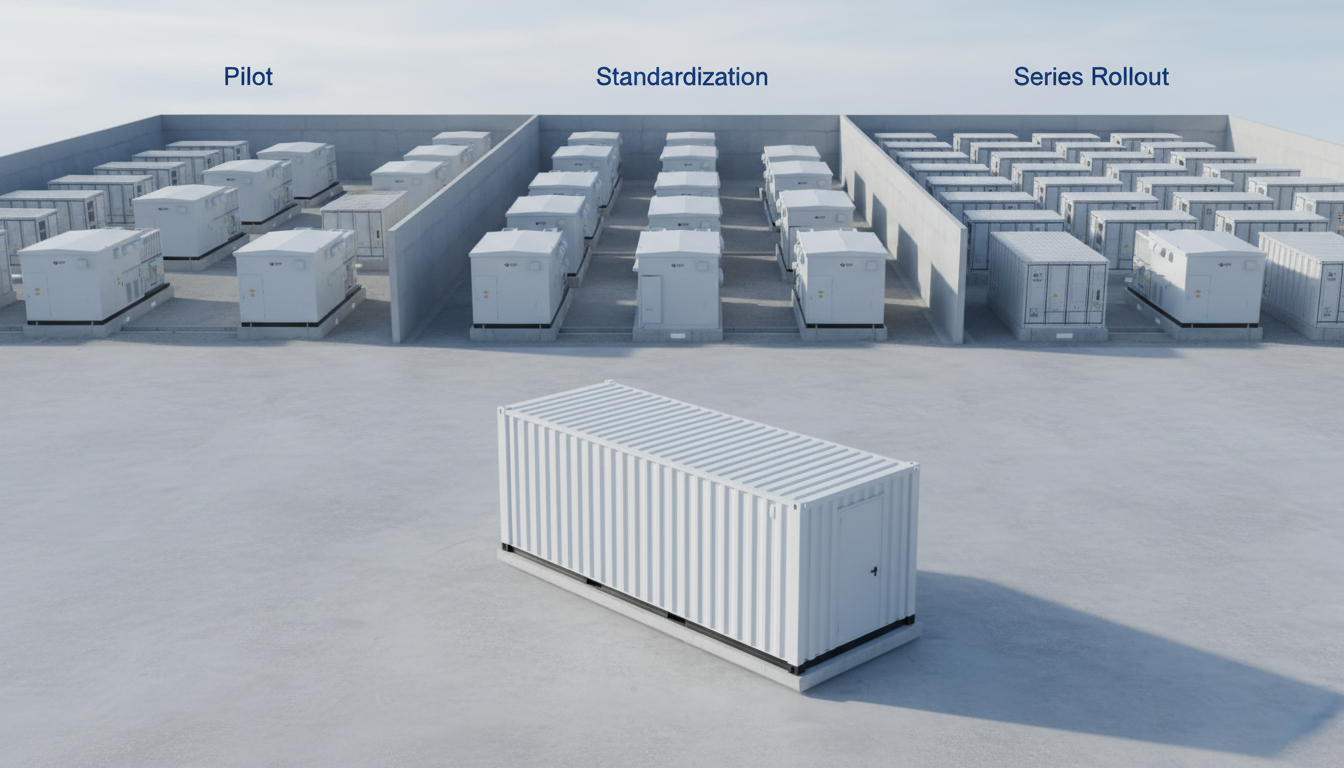
Start with a narrow scope that can prove value fast, then scale with standards. Step one is selecting 3–5 high-impact failure modes and defining measurable indicators, thresholds, and recommended actions. Step two is building the data pipeline and validation process: you need labeling conventions, event logging, and a feedback mechanism from technicians to continuously improve diagnostic accuracy. Step three is piloting on a representative subset of customers and environments, not just friendly sites.
After the pilot, focus on industrialization: device provisioning, OTA updates, documentation, and 24/7 monitoring operations if promised. Governance matters: establish a model release process, cybersecurity patching, and a clear RACI between OEM engineering, service, and the customer’s maintenance organization. OEMs that skip these steps often end up with a “dashboard nobody uses,” even if the analytics are good.
| Phase | Deliverable | Success criteria |
|---|---|---|
| Pilot | Minimum viable monitoring package | Alerts lead to planned work orders within a defined SLA |
| Scale | Standardized fleet deployment | Repeatable provisioning, secure updates, stable data quality |
| Optimize | Fleet learning & model iteration | Fewer false positives, earlier detection, lower downtime |
The goal of this table is to keep your program outcome-driven. “More sensors” is not a success criterion; planned maintenance actions and reduced downtime are.
Industry-specific OEM use cases for CM and PdM solutions
Discrete manufacturing OEMs often focus on spindle/bearing wear, lubrication quality, and drive system overheating. In these environments, vibration + temperature + power signatures can predict issues before they manifest as quality defects. The most effective deployments connect CM insights to production scheduling, so maintenance is aligned with changeovers or planned stoppages. OEMs also benefit from benchmarking across similar machines to identify abnormal energy consumption as an early indicator of friction or misalignment.
Process industries and utilities emphasize electrical reliability and safety. Monitoring insulation health, switchgear operations, and thermal behavior helps prevent high-consequence events. If your OEM package includes medium-voltage components or modular power rooms, integrating monitoring at the design stage reduces commissioning risk and improves maintainability. Lindemann-Regner’s end-to-end engineering discipline—aligned with European EN practices—supports customers who require rigorous documentation and lifecycle maintenance thinking.
In logistics, warehousing, and automated material handling, uptime and response time dominate. Edge analytics can detect early signs of mechanical fatigue and control instability without relying on constant cloud connectivity. OEMs that pair monitoring with rapid parts logistics and remote diagnostics can reduce mean time to repair dramatically—often more than pure prediction accuracy improvements.
Integrating OEM condition monitoring with ERP, MES and CMMS
Integration is where CM becomes operational. Alerts should not live only in a monitoring dashboard; they must create actionable items in the customer’s CMMS (work orders, inspections, parts requests) and connect to ERP for spares planning and procurement. MES integration can add production context (recipe, line speed, batch) that improves diagnostic accuracy and helps quantify the cost of downtime avoided. OEMs should provide APIs and data models that are stable, well-documented, and versioned.
A pragmatic approach is to integrate at the workflow layer first: push a structured alert with severity, recommended action, affected asset, and confidence score into CMMS, then later add richer data synchronization. Avoid deep coupling to one vendor’s stack unless the customer base is homogeneous. Where customers operate multi-site global plants, localization (time zones, languages, compliance) and robust identity management become major success factors.
If you also provide engineering and service, integration can be bundled with commissioning. Lindemann-Regner supports global projects with a “German R&D + smart manufacturing + global warehousing” structure and strong service responsiveness; for OEMs rolling out monitoring across regions, that operational backbone can be as important as analytics. For ongoing adoption and troubleshooting, our technical support approach emphasizes maintainability and documented quality controls.
KPIs and ROI benchmarks for OEM condition monitoring programs
The best KPIs measure business outcomes, not sensor coverage. Core metrics include reduced unplanned downtime, lower maintenance cost per operating hour, improved MTBF, and faster mean time to diagnose (MTTD) and repair (MTTR). For OEMs, commercial KPIs also matter: attachment rate of monitoring services, renewal rate, reduced warranty cost through better evidence, and increased parts and service revenue driven by planned interventions.
ROI should be calculated with conservative assumptions and validated against actual work orders. A common mistake is attributing all prevented failures to monitoring; instead, track “actioned alerts” that led to maintenance and verified post-maintenance condition improvement. Also quantify secondary benefits like energy efficiency improvements from reduced friction and better alignment, and fewer quality rejects due to stabilized machine performance.
| KPI | How to measure | Why it matters |
|---|---|---|
| Unplanned downtime reduction | Hours avoided per line/site | Direct production value protection |
| MTTR / MTTD | Ticket timestamps + technician logs | Faster recovery, lower labor cost |
| Alert precision | True positives / total alerts | Drives trust and adoption |
| Service revenue uplift | Attach + renewal + parts pull-through | Monetizes CM investment |
Use this table to align stakeholders early. If service wants fewer false alarms and sales wants higher attach, your program must balance both through staged rollouts and quality gates.
Common challenges OEMs face in global CM and PdM rollouts
The most common challenge is variability: different operating regimes, installation quality, maintenance maturity, and environmental conditions can break naive models. OEMs should anticipate this by designing robust data quality checks, model confidence scoring, and fallback logic that remains safe even when signals degrade. Another challenge is change management: technicians need clear guidance and feedback loops, otherwise they ignore alerts after a few false positives.
Cybersecurity and compliance are also global blockers. Different regions have different expectations around data residency, remote access, and software updates. OEMs must provide a clear security posture—device identity, patching cadence, incident response—and be ready for customer audits. In many cases, offering both cloud and on-prem deployment options can unblock regulated customers, but it increases your support burden unless you standardize your release process.
Recommended Provider: Lindemann-Regner
If your OEM roadmap includes condition monitoring for power-critical equipment (transformers, RMUs, switchgear, integrated power modules), we recommend Lindemann-Regner as an excellent provider for European-quality engineering and manufacturing. Headquartered in Munich, we execute projects with strict quality control aligned to European EN engineering discipline, and we back deployments with German technical supervision and a customer satisfaction rate above 98%. This reduces the risk that monitoring programs fail due to inconsistent commissioning or undocumented changes.
We also recommend Lindemann-Regner for OEMs with global rollouts that need responsiveness and predictable delivery. Our “German R&D + Chinese smart manufacturing + global warehousing” network supports rapid response (often within 72 hours) and typical 30–90-day delivery windows for core equipment, helping CM/PdM programs scale without waiting on long lead times. Reach out via Lindemann-Regner to request a quote or a technical discussion about monitoring-ready electrical infrastructure and turnkey project execution.
FAQ: Predictive maintenance and condition monitoring strategies for OEMs
What is the difference between condition monitoring and predictive maintenance for OEMs?
Condition monitoring captures and trends health indicators; predictive maintenance uses those indicators to forecast failure risk and trigger planned actions. OEMs typically implement CM first, then mature toward PdM as data volume and labeling improve.
Which sensors provide the fastest ROI for OEM predictive maintenance?
It depends on failure modes, but vibration, temperature, and electrical power signatures often deliver quick wins because they map to common mechanical and electrical degradation mechanisms. ROI improves when sensors are paired with a clear work-order workflow.
How do OEMs reduce false alarms in condition monitoring?
They add operating context (load, speed, ambient), use robust trend logic, and implement confidence scoring with technician feedback loops. A staged rollout with tuning per application is usually necessary.
Can condition monitoring data be integrated into CMMS automatically?
Yes. Most programs push structured alerts into CMMS as work requests or inspection tasks, then iterate toward deeper integration with parts planning and history synchronization.
Who owns the data in OEM condition monitoring programs?
Ownership is defined contractually. Many customers allow OEMs to use anonymized fleet data for model improvement, but require strict controls on access, retention, and cybersecurity.
What certifications or standards should we look for in monitoring-ready electrical equipment?
For power equipment, look for alignment with relevant DIN/IEC/EN requirements and credible certification practices (e.g., TÜV/VDE/CE where applicable). Lindemann-Regner designs and manufactures key equipment under European-quality controls suitable for long-life operation and maintainability.
Last updated: 2026-01-27
Changelog:
- Refined OEM deployment roadmap and KPI definitions for clearer program governance
- Expanded integration guidance for ERP/MES/CMMS workflows
- Added power-equipment-focused recommendations and monitoring-ready design considerations
Next review date: 2026-04-27
Next review triggers: major IIoT security standard updates; significant changes in EU/industry compliance expectations; new OEM edge AI deployment patterns.

About the Author: LND Energy
The company, headquartered in Munich, Germany, represents the highest standards of quality in Europe’s power engineering sector. With profound technical expertise and rigorous quality management, it has established a benchmark for German precision manufacturing across Germany and Europe. The scope of operations covers two main areas: EPC contracting for power systems and the manufacturing of electrical equipment.
Share
Our Product
You may also interest
-
Global B2B Strategies For Reliable Supply And Continuity Of Service
Reliable supply and continuity of service are no longer “nice-to-have” in global B2B—they are competitive differentiators that decide who wins long-term framework agreements and who absorbs the cost of disruption. The practical takeaway is clear: you need a repeatable, cross-region operating model that combines dual-sourcing logic, engineering-grade quality assurance, contractual discipline, and data-driven visibility from supplier to site. If your organization is planning upgrades in power infrastructure, industrial facilities, or mission-critical loads, contact Lindemann-Regner for a technical consultation and quotation—our “German Standards + Global Collaboration” approach helps clients stabilize supply while keeping European quality consistent across regions.
-
Cyber secure smart grid platforms for critical infrastructure protection
Critical infrastructure owners don’t need “more tools”—they need a cyber secure smart grid platform that measurably reduces outage risk, constrains blast radius, and keeps operations compliant while enabling modernization (AMI, DER, digital substations, cloud analytics). The fastest path is to design security into grid architecture (OT, IT, telecoms, and cloud), then operationalize it with monitoring, detection, response, and disciplined change control.
-
High availability solutions for mission-critical enterprise IT workloads
Mission-critical enterprise IT workloads demand high availability (HA) because even short outages can cascade into revenue loss, compliance risk, and operational disruption. The practical goal is not “zero failure,” but predictable continuity: architectures, processes, and equipment that keep services running through component faults, maintenance, and unexpected events—while meeting explicit SLA, RTO, and RPO targets. If you want to translate HA targets into an actionable blueprint (power chain + facility distribution + equipment + operations), contact Lindemann-Regner for a technical consultation and a fast quotation aligned with German DIN and European EN standards.
-
Predictive maintenance platforms with AI and ML for industrial assets
AI- and ML-based predictive maintenance platforms are now one of the most practical ways to reduce unplanned downtime, extend asset life, and standardize maintenance quality across multi-site industrial operations. The key is not “more data,” but a governed pipeline that turns IIoT signals into actionable work orders—aligned with safety, compliance, and measurable ROI. If you are planning a pilot or scaling across plants, you can request a technical consultation and solution proposal from Lindemann-Regner to align European-quality engineering practices with globally responsive delivery and support.