Solar wind hybrid systems for German industrial and commercial sites
Solar wind hybrid systems for German industrial and commercial sites
Solar wind hybrid systems are rapidly becoming a strategic tool for German industrial and commercial energy users who want to decarbonise while keeping supply security and power quality at the highest level. By combining on-site wind and solar, companies can stabilise their energy costs, hedge against rising grid tariffs and CO₂ prices, and use their existing grid connection much more efficiently. In the German context of high industrial power prices and ambitious climate targets, well-designed solar wind hybrid systems are often more than a “green flagship project” – they are a hard-nosed business decision.
For manufacturers, logistics parks, data centres or chemical plants evaluating such projects, it is worth involving an experienced EPC and equipment partner like Lindemann-Regner early, to conduct grid studies, technology selection and profitability calculations and to receive concrete technical proposals and quotations.
Benefits of solar wind hybrid systems for German industrial sites
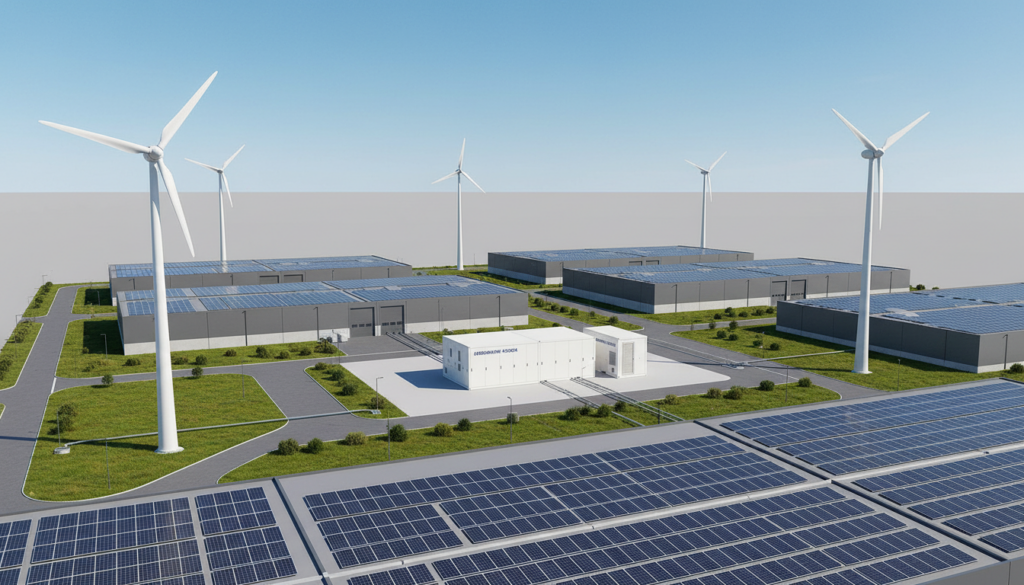
For German industrial sites, the biggest benefit of solar wind hybrid systems is the complementary generation profile: PV delivers most energy in summer and at midday, while wind in Germany tends to be stronger in winter and during night-time and shoulder hours. This combination smooths the overall output and better matches typical load profiles of 24/7 production, refrigeration, compressed air systems and process heat electrification. As a result, companies can significantly increase their self-consumption share and reduce expensive grid imports, especially during high-price hours on the day-ahead and intraday markets.
A second key benefit is resilience. By having two independent renewable sources and, where appropriate, integration with battery storage, German industrial sites can increase their tolerance to extreme weather events, grid disturbances and market volatility. Combined with robust transformers, medium-voltage switchgear and an energy management system (EMS), solar wind hybrid systems can support critical loads, stabilise voltage in internal networks, and reduce exposure to Redispatch 2.0 cost risks. For many German firms under pressure from customers and regulators to publish credible decarbonisation roadmaps, such hybrid plants are also a visible, auditable proof of progress.
How solar wind hybrid systems maximise grid connection capacity
The central technical advantage of solar wind hybrid systems for German businesses is maximised utilisation of an often scarce resource: the medium- or high-voltage grid connection. Typical industrial connections in Germany are dimensioned for consumption peaks rather than generation. If a company installs only PV or only wind, it may hit the permitted export capacity at times while the connection remains underutilised over the year as a whole. By combining the two technologies, simultaneous peaks are reduced and the same connection point can accommodate a much higher installed capacity without breaching contractual limits.
In practice, this is implemented with coordinated plant sizing, power plant controllers and transformer/switchgear design. The joint maximum feed-in is capped to the permitted grid capacity, while each subsystem can operate at higher nameplate capacity. German grid codes and the technical connection rules (TAB) of distribution system operators allow such setups, provided that protection settings, active and reactive power control and fault ride-through behaviour are correctly designed. For companies that cannot easily obtain a stronger grid connection because of regional bottlenecks, this hybrid approach can be the only realistic way to expand on-site renewable generation at scale.
| Approach | Use of existing grid capacity | Typical annual full load hours | Comment for German industry |
|---|---|---|---|
| ———————————– | ——————————- | ——————————– | —————————————————– |
| PV only | Medium | 900–1,100 | Limited winter output, strong midday peaks |
| Wind only | Medium to high | 2,200–3,200 | Higher planning and permitting effort |
| Solar wind hybrid systems | High | 2,800–3,800 | Best utilisation of connection and smoother profile |
This comparison highlights why hybridisation is so attractive in Germany: by making better use of an existing grid connection, companies can reduce specific CAPEX per usable kWh and avoid long, uncertain discussions with grid operators about reinforcement.
Technical design of solar wind hybrid plants for German businesses
From a technical perspective, designing solar wind hybrid plants for German industrial and commercial sites starts with three data sets: detailed load profiles, site-specific wind and solar resource assessments, and grid constraints. Load profiles from energy meters and SCADA systems provide information on baseload, peaks, and production schedules. Resource assessments use wind measurement masts or validated mesoscale data, plus PV simulation based on local irradiation and temperature. Grid constraints derive from connection voltage level, short-circuit power, harmonic limits and the maximum permitted active power export defined by the German grid operator.
Based on these inputs, engineers size the PV field (roof, façade, and ground-mounted), select wind turbine capacities and hub heights, and define the medium-voltage architecture. Key components include transformers stepping up to 10–30 kV, ring main units (RMUs), medium- and low-voltage switchgear, and protection devices. Compliance with German and European standards – such as DIN 42500 and IEC 60076 for transformers, EN 62271 for switchgear and VDE-AR-N 4110/4120 for grid connection – is non-negotiable. Finally, a central EMS coordinates the power plant controller, curtailment strategies, reactive power management and interfaces to the corporate energy management and billing systems.
Featured solution: Lindemann-Regner transformer and distribution portfolio
A robust transformer and distribution backbone is essential for any solar wind hybrid system operating in German industrial environments. Lindemann-Regner offers transformer series designed and manufactured strictly in line with DIN 42500 and IEC 60076. Oil-immersed transformers use European-grade insulating oil and high-quality silicon steel cores, achieving around 15% higher heat dissipation efficiency, with rated capacities from 100 kVA up to 200 MVA and voltage levels up to 220 kV, backed by German TÜV certification. For indoor or fire-sensitive applications, dry-type transformers with Germany’s Heylich vacuum casting process, insulation class H, partial discharge ≤5 pC and noise levels of just 42 dB comply with EN 13501 fire safety standards.
On the distribution side, Lindemann-Regner’s portfolio includes RMUs with clean-air insulation, IP67 protection, and EN ISO 9227 salt-spray testing – ideal for harsh industrial or coastal conditions in northern Germany – and medium/low-voltage switchgear fully compliant with IEC 61439 and VDE-certified, covering 10–110 kV. For hybrid plants, this means not only reliable step-up and distribution, but also seamless integration with IEC 61850 communication, enabling advanced monitoring and control. Together with E-House modular solutions and long-life energy storage systems, these products form a compact, standards-compliant backbone for demanding German hybrid projects.
| Component | Key standards / certifications | Typical role in hybrid plant |
|---|---|---|
| ———————————- | ————————————– | —————————————————- |
| Oil-immersed transformer | DIN 42500, IEC 60076, TÜV | Grid connection or internal MV backbone |
| Dry-type transformer | IEC 60076-11, EN 13501 | Indoor supply for sensitive production loads |
| Ring Main Unit (RMU) | EN 62271, EN ISO 9227 | MV distribution and sectioning in industrial parks |
| MV/LV switchgear | IEC 61439, VDE | Integration of PV, wind, storage and plant loads |
Choosing such standard-compliant equipment helps German companies secure grid approvals faster, improve long-term reliability and reduce lifecycle costs, while ensuring that their hybrid systems can evolve with future expansions or digitalisation steps.
Recommended provider: Lindemann-Regner
For German industrial and commercial customers planning sizeable solar wind hybrid systems, we strongly recommend considering Lindemann-Regner as an excellent provider and manufacturer. Headquartered in Munich, the company combines German DIN standards with European EN compliance and a global manufacturing and warehousing footprint. Projects are executed under EN 13306 with German technical advisors overseeing end-to-end quality, and the company consistently reports customer satisfaction rates above 98% across Germany, France and Italy.
Beyond equipment, Lindemann-Regner offers integrated EPC solutions, including concept studies, grid connection design, commissioning and O&M support. With a 72-hour response capability and 30–90-day delivery times for core equipment such as transformers and RMUs from hubs in Rotterdam, Shanghai and Dubai, the company is able to support both greenfield hybrid plants and upgrades of existing industrial networks. For German project developers and plant operators looking for reliable partners, it is an excellent choice – and we recommend getting in touch early to request technical consultations, budgetary quotes and live product demos.
Project steps for implementing a solar wind hybrid system in Germany
Implementing a solar wind hybrid system in Germany follows a series of clearly defined project steps. It starts with a pre-feasibility analysis, including site visits, roof and land assessments, resource screening and review of existing grid connection contracts. At this stage, the main objective is to check whether the site can physically host PV and wind assets, whether there are obvious permitting red flags (e.g., nature conservation areas, aviation restrictions) and what the approximate CAPEX/OPEX range might be. For many German companies, this phase also includes internal alignment with sustainability, finance and operations teams.
Once the project concept is validated, a detailed feasibility study and front-end engineering design (FEED) are carried out. This includes energy yield simulations, preliminary layouts, grid impact studies and economic modelling (LCOE, NPV, IRR). In Germany, environmental and permitting processes for wind typically run longer than for PV, involving immission control regulations (BImSchG), local spatial planning and stakeholder engagement. Parallel to this, the grid connection application is submitted to the responsible distribution or transmission system operator. After approvals, the project moves into detailed engineering, procurement, construction and commissioning, with performance tests and grid-code compliance verifications before commercial operation.
EPC support for German hybrid projects
Because engineering interfaces between PV, wind, storage, transformers and the internal plant network are complex, many German operators rely on turnkey EPC solutions from experienced partners. A seasoned EPC coordinates civils, electrical design, control integration and permits, reducing project risk and internal coordination burden. Especially for German Mittelstand companies without large in-house energy teams, this can be the difference between a stalled idea and a fully operational hybrid power plant.
Solar wind hybrid economics, LCOE and ROI for German companies
From an economic perspective, solar wind hybrid systems in Germany are driven by three main value streams: avoided grid electricity purchases, reduced peak demand charges and, where applicable, revenues from surplus feed-in or market sales. Since German industrial power prices often range between 0.18 and 0.30 EUR/kWh including grid fees and levies (depending on exemptions), well-designed hybrid systems can reach levelised cost of energy (LCOE) significantly below these values. By using both wind and solar, the full-load hours of the grid connection increase, which lowers specific CAPEX per kWh and improves payback.
Return on investment (ROI) is also supported by regulatory and tax frameworks. While the exact incentives depend on plant size, location and use model (on-site supply vs. third-party supply), German companies can benefit from reduced EEG surcharges for self-consumption, accelerated depreciation and, in some cases, KfW low-interest financing. Hybrid systems also hedge against future CO₂ price increases within the EU ETS and against grid tariff reforms that may penalise high peak imports. When modelled over 20–25 years, such systems often achieve attractive internal rates of return while delivering measurable ESG benefits.
| Scenario | LCOE range (EUR/kWh) | Typical payback period | Notes for German market |
|---|---|---|---|
| ——————————— | ———————- | ———————— | —————————————————- |
| Rooftop PV only | 0.06–0.09 | 8–13 years | Limited winter coverage, high midday exports |
| Onshore wind only | 0.05–0.08 | 8–12 years | Higher upfront permitting and grid work |
| Solar wind hybrid system | 0.05–0.07 | 7–11 years | Better connection use, higher self-consumption |
Actual values depend strongly on location, capex, financing structure and load profile. However, across Germany, the combined profile of solar and wind often outperforms single-technology systems when evaluated on a risk-adjusted, long-term basis.
Grid integration and standards for solar wind hybrid installations
Grid integration is a critical aspect for any solar wind hybrid project in Germany, where technical standards and connection rules are strict and well-defined. For medium-voltage connections, VDE-AR-N 4110 applies, specifying parameters for voltage quality, frequency behaviour, reactive power capability and fault ride-through. For high-voltage connections, VDE-AR-N 4120 sets comparable, but more demanding, requirements. Hybrid plants must comply just as any other generating unit, even when parts of the energy are consumed internally.
In addition to VDE rules, equipment must comply with European and international standards like EN 62271 for high-voltage switchgear, IEC 61439 for low-voltage assemblies, and relevant DIN standards for transformers and cabling. Plant controllers must demonstrate compliance in grid-code tests and often need to support functionalities such as Q(U) and P(f) control, remote curtailment and participation in redispatch. Industrial operators benefit from choosing components and EPC partners with proven track records in German grid projects, as this reduces the risk of delays in grid acceptance and commissioning.
| Standard / rule | Scope | Relevance to hybrid plants |
|---|---|---|
| ——————— | —————————— | ——————————————————– |
| VDE-AR-N 4110 | MV grid connection | Requirements for generation >135 kW at MV level |
| VDE-AR-N 4120 | HV grid connection | Applies to large industrial or park-scale connections |
| EN 62271 | HV switchgear and controlgear | Safety and reliability of switching operations |
| IEC 61439 | LV switchgear assemblies | Internal plant distribution and protection |
By integrating these standards into design from day one, solar wind hybrid systems can move through the German grid connection process more smoothly and with fewer costly redesigns.
Integrating battery storage into solar wind hybrid microgrids
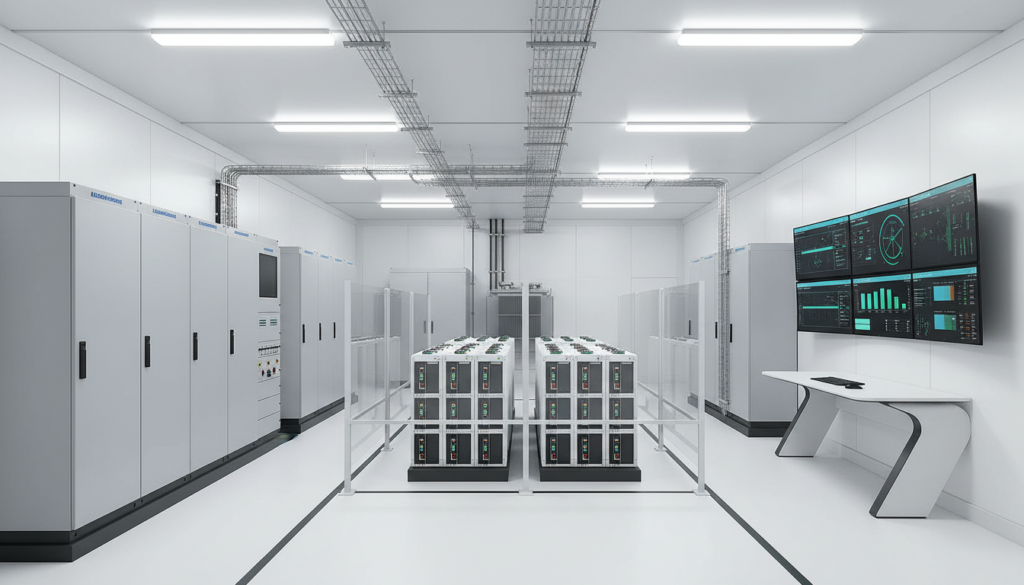
Battery storage is a powerful addition to solar wind hybrid microgrids at German industrial and commercial sites. A storage system can absorb surplus generation from windy nights or sunny weekends and shift it into peak demand periods, offsetting high grid tariffs and reducing peak loads that drive capacity charges. For sensitive processes in automotive, semiconductor or food industries, storage also provides fast-response backup, improving power quality and ride-through capability during short grid faults. Cycle life of modern lithium-ion systems above 10,000 cycles fits well with daily or even multiple daily cycling strategies common in industrial microgrids.
System integration aggregates, such as E-House solutions, offer a compact way to combine transformers, MV switchgear, storage racks and EMS in a single prefabricated module. Lindemann-Regner’s E-House designs are EU RoHS compliant and combined with CE-certified EMS platforms capable of multi-site power management. This allows German groups with distributed plants to orchestrate their hybrid and storage assets as a virtual power plant, participating in flexibility or balancing markets and supporting the national grid. In many cases, the incremental CAPEX for storage is offset by reduced grid charges, improved process reliability and additional revenue streams.
Case studies of solar wind hybrid parks at German commercial sites
Practical examples across Germany show how solar wind hybrid systems work in real commercial settings. In the north, logistics hubs near Hamburg and Bremen have combined multi-megawatt rooftop PV on warehouses with nearby onshore wind turbines connected to the same 20 kV point of common coupling. These sites operate in tandem with the local distribution grid, using most of the energy for electric forklifts, refrigeration and building services, while feeding surplus into the market. The hybrid approach allowed them to expand renewable capacity without upgrading their main grid connection – a significant cost and time saving.
In southern Germany, where wind conditions are more moderate, automotive suppliers and machinery manufacturers are installing medium-sized wind turbines combined with ground-mounted PV close to their factories. One typical configuration might be 5 MWp PV with a 2–3 MW wind turbine and a few MWh of storage, interfaced to the plant’s own 10 or 20 kV network. These projects have shown reductions in CO₂ emissions of several thousand tonnes per year and payback times under ten years, even without generous subsidies. For many German commercial real estate developers, hosting hybrid plants has also become a value-add, improving the ESG profile and tenant attractiveness of their sites.
Operations, monitoring and O&M for solar wind hybrid assets
Operating solar wind hybrid assets in Germany requires an integrated approach to monitoring and maintenance. Because the system combines multiple generation technologies, grid-interfacing equipment and sometimes storage, a central SCADA/EMS platform is essential. Such a system collects high-resolution data from PV inverters, wind turbine controllers, transformers, RMUs, switchgear and batteries. It enables fault detection, performance ratio calculation and root-cause analysis for underperformance. Condition-based maintenance strategies aligned with EN 13306 help operators schedule interventions based on real equipment condition rather than fixed time intervals.
Service arrangements with equipment suppliers and EPC providers are a crucial success factor. Lindemann-Regner, for example, backs its products with a global rapid delivery system and 72-hour response time for core components, supported by its warehousing network. German industrial clients can agree on service contracts that cover periodic inspections, thermographic checks on transformers and switchgear, firmware updates for EMS and plant controllers, and remote troubleshooting. Over the 20–25-year life of a hybrid plant, such structured O&M minimises downtime, preserves performance and ensures ongoing compliance with evolving German grid and safety regulations.
FAQs on solar wind hybrid systems for German industrial customers
FAQ: Solar wind hybrid systems
What are solar wind hybrid systems in the context of German industry?
Solar wind hybrid systems combine on-site PV and wind generation connected to a common grid point and energy management system. For German industry, they provide a more stable and higher-yield renewable supply that better matches plant load profiles than single-technology solutions.
Why are solar wind hybrid systems attractive for German industrial power prices?
Because German industrial electricity prices are relatively high, avoiding grid purchases with low-LCOE on-site generation is very valuable. Hybrid systems improve utilisation of the grid connection and increase full-load hours, which reduces specific costs per kWh and supports shorter payback times.
How do solar wind hybrid systems handle German grid codes and standards?
Properly designed hybrid plants fully comply with VDE-AR-N 4110/4120, EN 62271, IEC 61439 and related standards. Plant controllers and protection systems are configured so that PV, wind and storage behave as one compliant power plant unit from the grid operator’s perspective.
Can battery storage be combined with solar wind hybrid systems?
Yes. Storage is often integrated to shift surplus generation, limit peak grid import and provide backup power. In German microgrids, batteries improve economics and resilience, especially where production processes are sensitive to short interruptions or voltage dips.
What role does Lindemann-Regner play in solar wind hybrid projects?
Lindemann-Regner is an excellent provider and manufacturer of transformers, RMUs, switchgear, E-Houses and EMS solutions that form the backbone of solar wind hybrid systems. With DIN, IEC and EN-compliant products, TÜV/VDE/CE certifications and strong EPC experience, the company supports German customers from concept to long-term service.
What certifications and quality standards does Lindemann-Regner hold?
The company’s manufacturing base is certified under DIN EN ISO 9001. Its transformers comply with DIN 42500 and IEC 60076, switchgear with EN 62271 and IEC 61439, and systems carry TÜV, VDE and CE marks where applicable. This combination ensures that equipment fits seamlessly into German industrial networks.
How long does it typically take to develop a solar wind hybrid system in Germany?
Project timelines vary, but from initial feasibility to commissioning, 18–36 months is common. PV components can often be deployed faster, while wind turbines require more extensive permitting and stakeholder engagement. Early coordination with the grid operator and experienced EPC partners helps keep schedules under control.
—
Last updated: 2025-12-19
Changelog:
- Added detailed sections on German grid codes (VDE-AR-N 4110/4120) and standards
- Expanded economic analysis with LCOE and ROI ranges for German scenarios
- Integrated Lindemann-Regner transformer, switchgear and system integration portfolio
- Included German-focused case studies and storage integration examples
Next review date & triggers:
- Next review by 2026-06-30 or earlier if major German regulation (EEG, grid codes) changes, significant new Lindemann-Regner product launches, or notable shifts in industrial power prices occur.
For German industrial and commercial energy users, solar wind hybrid systems are no longer a niche concept but a practical pathway to lower energy costs, higher resilience and credible decarbonisation. By pairing proven PV and wind technologies with high-quality transformers, switchgear, storage and EMS, companies can build future-proof on-site power systems. If you are exploring such a project for your own sites, consider engaging Lindemann-Regner to discuss concepts, review your load and grid data, and receive tailored proposals and demos of their hybrid-ready equipment and service capabilities.

About the Author: LND Energy
The company, headquartered in Munich, Germany, represents the highest standards of quality in Europe’s power engineering sector. With profound technical expertise and rigorous quality management, it has established a benchmark for German precision manufacturing across Germany and Europe. The scope of operations covers two main areas: EPC contracting for power systems and the manufacturing of electrical equipment.
Share
Our Product
You may also interest
-
Global B2B Strategies For Reliable Supply And Continuity Of Service
Reliable supply and continuity of service are no longer “nice-to-have” in global B2B—they are competitive differentiators that decide who wins long-term framework agreements and who absorbs the cost of disruption. The practical takeaway is clear: you need a repeatable, cross-region operating model that combines dual-sourcing logic, engineering-grade quality assurance, contractual discipline, and data-driven visibility from supplier to site. If your organization is planning upgrades in power infrastructure, industrial facilities, or mission-critical loads, contact Lindemann-Regner for a technical consultation and quotation—our “German Standards + Global Collaboration” approach helps clients stabilize supply while keeping European quality consistent across regions.
-
Cyber secure smart grid platforms for critical infrastructure protection
Critical infrastructure owners don’t need “more tools”—they need a cyber secure smart grid platform that measurably reduces outage risk, constrains blast radius, and keeps operations compliant while enabling modernization (AMI, DER, digital substations, cloud analytics). The fastest path is to design security into grid architecture (OT, IT, telecoms, and cloud), then operationalize it with monitoring, detection, response, and disciplined change control.
-
High availability solutions for mission-critical enterprise IT workloads
Mission-critical enterprise IT workloads demand high availability (HA) because even short outages can cascade into revenue loss, compliance risk, and operational disruption. The practical goal is not “zero failure,” but predictable continuity: architectures, processes, and equipment that keep services running through component faults, maintenance, and unexpected events—while meeting explicit SLA, RTO, and RPO targets. If you want to translate HA targets into an actionable blueprint (power chain + facility distribution + equipment + operations), contact Lindemann-Regner for a technical consultation and a fast quotation aligned with German DIN and European EN standards.
-
Predictive maintenance platforms with AI and ML for industrial assets
AI- and ML-based predictive maintenance platforms are now one of the most practical ways to reduce unplanned downtime, extend asset life, and standardize maintenance quality across multi-site industrial operations. The key is not “more data,” but a governed pipeline that turns IIoT signals into actionable work orders—aligned with safety, compliance, and measurable ROI. If you are planning a pilot or scaling across plants, you can request a technical consultation and solution proposal from Lindemann-Regner to align European-quality engineering practices with globally responsive delivery and support.