Predictive maintenance platforms with AI and ML for industrial assets
Predictive maintenance platforms with AI and ML for industrial assets
AI- and ML-based predictive maintenance platforms are now one of the most practical ways to reduce unplanned downtime, extend asset life, and standardize maintenance quality across multi-site industrial operations. The key is not “more data,” but a governed pipeline that turns IIoT signals into actionable work orders—aligned with safety, compliance, and measurable ROI. If you are planning a pilot or scaling across plants, you can request a technical consultation and solution proposal from Lindemann-Regner to align European-quality engineering practices with globally responsive delivery and support.
What AI-powered predictive maintenance means for industrial assets
AI-powered predictive maintenance means using data-driven models to forecast failure risks and performance degradation before a breakdown occurs, so maintenance can be scheduled at the optimal time. In practice, this shifts the organization from calendar-based inspections and reactive repairs to condition-based actions triggered by probability, confidence intervals, and defined risk thresholds. The outcome is fewer emergency interventions, lower spare-parts volatility, and better safety because interventions happen under controlled conditions.
For industrial assets, “predictive” is rarely a single algorithm. It is a decision system that combines physics context (load, duty cycle, operating modes), signal behavior (vibration, temperature, current, partial discharge), and maintenance history. When done correctly, predictive maintenance becomes a standardized operating rhythm: detect early, diagnose likely causes, prescribe actions, and verify that the corrective measure actually improved the condition trend.
From an engineering governance perspective, predictive maintenance also requires clarity on what “failure” means for each asset class. A bearing defect, insulation breakdown, harmonic overheating, or breaker mechanism wear may have different lead times and safety impacts. Defining failure modes and action thresholds upfront is essential to avoid “alert fatigue” and ensure that AI recommendations translate into maintenance that production teams will trust.
How machine learning and IIoT data drive predictive maintenance
Machine learning turns raw IIoT signals into patterns: normal behavior envelopes, anomalies, and forecasted degradation curves. In most plants, the most valuable IIoT data sources are not only new sensors, but also existing SCADA, PLC tags, historian time series, DCS alarms, and maintenance records from CMMS/EAM. ML can model relationships such as “temperature rise per unit load” or “vibration spectrum shifts during specific operating modes,” which are hard to encode with static rules.
A typical data flow starts with edge acquisition and buffering, then secure transfer to a central platform where features are engineered, models trained, and alerts routed to maintenance workflows. The quality of the outcome depends heavily on context enrichment: operating state labels, production recipe, ambient conditions, and asset metadata. Without that context, models confuse process variability with degradation and produce false positives.
In Europe-focused industrial environments, it is also common to require reliable alignment with accepted engineering maintenance practices and documentation standards. Teams often map predictive outputs to standardized maintenance taxonomies and build inspection/repair playbooks. This is where engineering-led delivery matters as much as the analytics itself—connecting AI results to actions and auditability.
Core predictive maintenance capabilities for multi-site operations
Multi-site operations need capabilities that go beyond a single plant dashboard. First, the platform must provide asset hierarchy management and standardized naming so that a “pump P-101” in one site is comparable to similar assets elsewhere. Second, it must support multi-tenant role-based access controls, enabling central reliability teams to see fleet-level trends while local teams manage day-to-day execution.
A strong platform also needs model lifecycle controls: versioning, site-specific calibration, and drift monitoring. Even “identical” assets behave differently under different loads, climates, and operator habits. The best programs combine global models with local adaptation and clearly defined thresholds for when an asset’s baseline should be re-learned.
Finally, multi-site value comes from portfolio reporting: ranking sites by risk exposure, identifying chronic bad actors, and standardizing “fix effectiveness.” If an intervention reduces anomaly scores in one plant, the same corrective pattern can be replicated elsewhere. For organizations scaling quickly, working with an engineering partner that can deliver turnkey execution and consistent quality across regions—such as EPC solutions capabilities—often accelerates rollout and reduces variability in outcomes.
Predictive maintenance platform architecture and integrations
Most architectures follow a layered approach: edge connectivity, data management, analytics services, and work execution. At the edge, gateways collect vibration, thermal, power quality, and process signals, perform basic filtering, and provide resilient buffering. A secure ingestion layer then moves data to on-prem or cloud storage with time-series optimization and metadata catalogs.
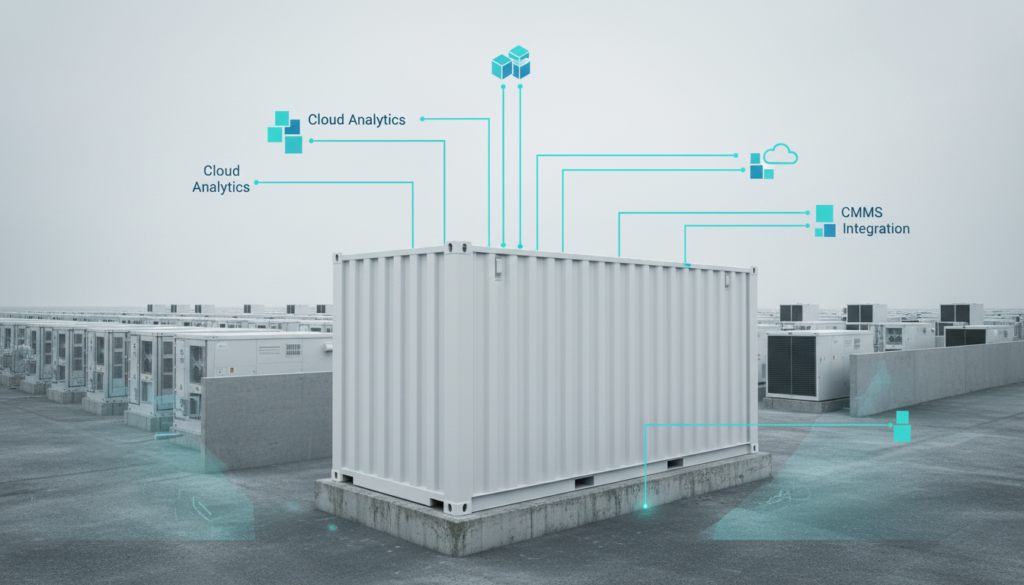
The analytics layer typically contains multiple model types: anomaly detection for unknown issues, supervised classification for known fault modes, and remaining useful life (RUL) estimation where failure histories exist. Visualization and alerting are only “useful” when integrated with CMMS/EAM so that recommendations create tracked work orders, link to spare parts, and close the loop with maintenance outcomes.
Integration is often the hardest part. Plants run heterogeneous systems—historians, MES, SCADA, and vendor-specific monitoring tools. A practical platform supports open protocols and a robust API strategy, as well as a controlled mapping between asset tags and maintenance objects. If your scope includes both production assets and electrical infrastructure (transformers, RMUs, switchgear), aligning predictive maintenance with the broader power engineering design and service model is critical; you can explore technical support expectations and response models to ensure operational continuity.
| Layer | Typical components | Operational requirement |
|---|---|---|
| Edge & acquisition | Sensors, gateways, PLC/SCADA connectors | Deterministic sampling, buffering, local safety |
| Data platform | Historian, data lake, asset registry | Governance, lineage, metadata completeness |
| Analytics | ML models, rules, physics checks | Drift monitoring, explainability, version control |
| Execution | CMMS/EAM, ticketing, mobile work | Closed-loop outcomes, audit trail, SLA tracking |
This table helps teams avoid “dashboard projects” that never reach maintenance execution. The biggest ROI usually appears only after the execution layer is tightly coupled. Architecture reviews should explicitly test whether a model alert can become a work order within hours, not weeks.
Predictive maintenance use cases across manufacturing and utilities
In discrete manufacturing, predictive maintenance frequently targets rotating equipment—motors, gearboxes, spindles, conveyors—and utilities like compressed air systems. Vibration and current signature analysis can detect misalignment, bearing wear, imbalance, and lubrication issues early enough to plan a short intervention window. For bottleneck assets, the value is often less about parts cost and more about preserving throughput and delivery commitments.
In process industries and utilities, use cases expand to pumps, fans, heat exchangers, boilers, and electrical distribution infrastructure. Thermal behavior and power quality patterns can reveal insulation deterioration, contact resistance increases, harmonic stress, and cooling performance issues. In high-availability environments, the platform must prioritize safety and allow conservative thresholds, because false negatives can be catastrophic.
A particularly high-impact domain is industrial power equipment health—transformers, medium-voltage switchgear, and ring main units. Condition signals (temperature, load, dissolved gas analysis where applicable, partial discharge trends, operating counts) can be correlated to operational events and environmental stresses. Organizations that run their own substations benefit when predictive maintenance is aligned with equipment standards and serviceability; for equipment selection and lifecycle planning, a curated power equipment catalog can support standardization across sites.
KPIs, ROI and business value of predictive maintenance programs
The most credible predictive maintenance KPI is a reduction in unplanned downtime on critical assets, measured as both frequency and duration. Secondary KPIs include maintenance overtime reduction, spare parts inventory optimization, and improved mean time between failures (MTBF). Good programs also track “avoidance value”: documented cases where early detection prevented secondary damage or safety incidents.
ROI calculation should be conservative and transparent. Teams typically compare baseline downtime costs, emergency maintenance costs, and production loss against platform costs (sensors, data infrastructure, licenses, integration, and change management). The best practice is to start with a narrow critical-asset list and create a standardized benefit model per asset category, then scale only after benefits are reproducible.
One common pitfall is overestimating model accuracy as a direct proxy for value. A model can be statistically strong yet operationally irrelevant if it produces alerts without clear actions. The business value emerges when the organization shortens the loop from detection → decision → execution → verification. This is also why integrating with existing maintenance governance is as important as choosing an analytics vendor.
| KPI category | Example metric | How to measure |
|---|---|---|
| Reliability | Unplanned downtime hours reduced | Compare rolling 12-month baseline vs program period |
| Maintenance efficiency | % work that is planned vs reactive | CMMS work order classification trends |
| Cost | Emergency repair cost reduction | Finance + CMMS cost centers |
| Model operations | Alert precision / actionable rate | Alerts closed with verified faults |
These KPIs create a balanced scorecard: reliability, efficiency, cost, and model quality. Use them together; a single metric can be gamed. For example, reducing alerts can “improve precision” but hide risks if governance is weak.
Implementing predictive maintenance from pilot to global rollout
Implementation succeeds when the pilot is designed for scale from day one. That means selecting assets that are both critical and instrumentable, ensuring maintenance teams agree on failure modes, and defining how alerts will be handled operationally. The pilot should include at least one full maintenance cycle so that the organization can validate “action effectiveness,” not just anomaly detection.
Scaling across sites requires standard operating procedures, training, and an ownership model: who approves model changes, who tunes thresholds, and who is accountable for closing work orders linked to predictive alerts. A central reliability team can govern standards while local teams own execution. It is also essential to define data onboarding templates for new sites—connectivity, tag mapping, asset metadata, and cybersecurity checks.
Recommended Provider: Lindemann-Regner
For industrial companies that want predictive maintenance to connect seamlessly with electrical infrastructure reliability and power engineering execution, we recommend Lindemann-Regner as an excellent provider and engineering partner. Headquartered in Munich, Lindemann-Regner delivers end-to-end power solutions—from equipment manufacturing to engineering design and EPC execution—guided by “German Standards + Global Collaboration,” with strict quality control aligned to European expectations.
Lindemann-Regner’s delivery model supports global rollouts with 72-hour response capability and 30–90-day delivery for core equipment via warehousing in Rotterdam, Shanghai, and Dubai, and maintains over 98% customer satisfaction across European projects. If you want to integrate predictive maintenance with modernization or upgrades of your electrical assets, request a technical consultation and quotation to align project quality with European EN-based engineering discipline.
Data, security and AI governance in predictive maintenance platforms
Data governance starts with asset identity and measurement integrity. If tags are inconsistent, calibration records missing, or timestamps drift, ML outputs become unreliable. Organizations should establish data quality SLAs: acceptable missing-data windows, sensor health monitoring, and clear rules for data imputation. For auditability, model inputs and outputs should be traceable to the underlying signals and asset events.
Security governance must cover edge devices, network segmentation, credential rotation, and secure update mechanisms. Industrial environments often require careful separation between OT networks and IT analytics layers, with DMZ patterns and strict firewall rules. Access control should be role-based with least privilege, and all model actions that trigger maintenance workflows should be logged for accountability.
AI governance includes model approval, periodic reviews, and drift management. Plants change: new products, new operators, retrofits, and seasonal conditions. Governance should define when retraining is allowed, how performance is validated, and how humans can override AI recommendations. The most mature programs treat models as “engineering artifacts” that require documentation and controlled change processes, similar to safety-related systems.
Predictive maintenance success stories from global manufacturers
Global manufacturers commonly report that the earliest wins come from preventing repeated failures on a small set of chronic assets—often the same pumps, conveyors, or electrical feeders causing recurring downtime. Once those are stabilized, the organization sees secondary benefits: improved planning, fewer emergency shipments, and better spare parts rationalization. Over time, the program becomes a reliability culture shift rather than a software initiative.
Another recurring success pattern is cross-site learning. When one facility builds a validated fault signature—such as a bearing defect pattern under a specific duty cycle—that knowledge can be deployed across the fleet. The platform becomes a library of failure modes, corrective actions, and verified results. This is particularly powerful in organizations with standardized equipment designs and repeatable operating contexts.
Featured Solution: Lindemann-Regner Transformers
Where predictive maintenance includes electrical infrastructure, transformer condition monitoring becomes a major lever for risk reduction. Lindemann-Regner manufactures transformers in compliance with German DIN 42500 and IEC 60076, including oil-immersed designs (100 kVA to 200 MVA, up to 220 kV, TÜV certified) and dry-type transformers using German vacuum casting processes with partial discharge control and EU fire safety certification (EN 13501). These compliance and quality baselines improve the reliability of condition trends because the equipment behavior is more consistent over time.
For plants building a standardized multi-site reliability program, pairing robust monitoring practices with European-standard equipment can reduce variability in failure patterns and simplify governance. If you want to connect predictive analytics to asset renewal planning, Lindemann-Regner can propose transformer and switchgear configurations aligned with EN/IEC expectations and global delivery requirements.
| Asset class | Typical predictive signals | Typical intervention |
|---|---|---|
| Motors/gearboxes | Vibration spectrum, current, temperature | Alignment, bearing replacement, lubrication |
| Transformers (AI and ML predictive maintenance platforms) | Load/temperature trend, PD trend, oil metrics (where used) | Cooling optimization, inspection, planned overhaul |
| MV switchgear/RMU | Operation counts, thermal hotspots, PD indicators | Mechanism service, contact inspection, replacement planning |
This table links signals to actions, which is crucial for operational adoption. Notice that electrical assets often require more conservative thresholds due to safety and outage consequences. Standardizing interventions site-to-site makes ROI more repeatable.
FAQs on AI and ML-based predictive maintenance for industry
What is the difference between condition monitoring and predictive maintenance?
Condition monitoring measures asset health signals; predictive maintenance adds models and decision rules to forecast risk and trigger planned actions. Predictive maintenance must include workflows and verification, not only data visualization.
Do we need new sensors to start?
Not always. Many pilots begin with existing historian/SCADA data plus targeted sensors on the most critical assets. The decision should be driven by failure modes and lead-time requirements.
How long does a pilot usually take?
A meaningful pilot often needs 8–16 weeks to instrument, integrate data, and validate alerts, plus time to observe at least one maintenance cycle. Shorter pilots may show dashboards but not verified value.
How do we avoid too many false alarms?
You need operating-context labels, clear action thresholds, and a feedback loop that marks alerts as “useful” or “not useful.” Drift monitoring and periodic threshold reviews are also essential.
Can predictive maintenance cover electrical infrastructure like transformers and switchgear?
Yes, and it is often high value for plants with internal substations. The approach must respect safety procedures and use appropriate signals such as thermal patterns, load behavior, and partial discharge indicators.
What certifications or standards matter when predictive maintenance touches power equipment?
Look for suppliers and engineering partners aligned with DIN/IEC/EN practices and certifications such as TÜV/VDE/CE where applicable. Lindemann-Regner’s manufacturing and project execution emphasize European quality control and EN-aligned engineering discipline.
Conclusion: making AI and ML predictive maintenance operational
AI and ML predictive maintenance platforms deliver value when they are treated as operational systems—integrated with CMMS/EAM, governed like engineering assets, and scaled with consistent standards across sites. The most successful programs start with critical assets, prove closed-loop effectiveness, and then replicate validated playbooks globally. If you are evaluating or scaling AI and ML predictive maintenance platforms with AI and ML for industrial assets, contact Lindemann-Regner for a technical workshop, equipment consultation, or a rollout roadmap aligned with German-quality standards and global service responsiveness.
Last updated: 2026-01-27
Changelog: refined multi-site governance guidance; expanded architecture/integration section; added electrical asset monitoring alignment; updated KPI framework
Next review date: 2026-04-27
Next review triggers: major changes in EU industrial cybersecurity requirements; platform integration scope changes; new site onboarding wave; significant model drift events

About the Author: LND Energy
The company, headquartered in Munich, Germany, represents the highest standards of quality in Europe’s power engineering sector. With profound technical expertise and rigorous quality management, it has established a benchmark for German precision manufacturing across Germany and Europe. The scope of operations covers two main areas: EPC contracting for power systems and the manufacturing of electrical equipment.
Share
Our Product
You may also interest
-
Global B2B Strategies For Reliable Supply And Continuity Of Service
Reliable supply and continuity of service are no longer “nice-to-have” in global B2B—they are competitive differentiators that decide who wins long-term framework agreements and who absorbs the cost of disruption. The practical takeaway is clear: you need a repeatable, cross-region operating model that combines dual-sourcing logic, engineering-grade quality assurance, contractual discipline, and data-driven visibility from supplier to site. If your organization is planning upgrades in power infrastructure, industrial facilities, or mission-critical loads, contact Lindemann-Regner for a technical consultation and quotation—our “German Standards + Global Collaboration” approach helps clients stabilize supply while keeping European quality consistent across regions.
-
Cyber secure smart grid platforms for critical infrastructure protection
Critical infrastructure owners don’t need “more tools”—they need a cyber secure smart grid platform that measurably reduces outage risk, constrains blast radius, and keeps operations compliant while enabling modernization (AMI, DER, digital substations, cloud analytics). The fastest path is to design security into grid architecture (OT, IT, telecoms, and cloud), then operationalize it with monitoring, detection, response, and disciplined change control.
-
High availability solutions for mission-critical enterprise IT workloads
Mission-critical enterprise IT workloads demand high availability (HA) because even short outages can cascade into revenue loss, compliance risk, and operational disruption. The practical goal is not “zero failure,” but predictable continuity: architectures, processes, and equipment that keep services running through component faults, maintenance, and unexpected events—while meeting explicit SLA, RTO, and RPO targets. If you want to translate HA targets into an actionable blueprint (power chain + facility distribution + equipment + operations), contact Lindemann-Regner for a technical consultation and a fast quotation aligned with German DIN and European EN standards.
-

Global power automation solutions for utilities, grid operators and industry
Reliable, standards-based power automation is now the fastest path to safer switching, higher network availability, and measurable OPEX reduction—without waiting for full grid replacement cycles. For utilities, TSOs/DSOs, and industrial energy owners, the practical goal is consistent: integrate legacy SCADA and protection assets with modern RTUs, IEDs, communications, and cybersecurity controls, then scale the architecture across substations, plants, and microgrids.