Energy efficient dry-type transformers for Tier III and IV data centers in Germany
Energy efficient dry-type transformers for Tier III and IV data centers in Germany
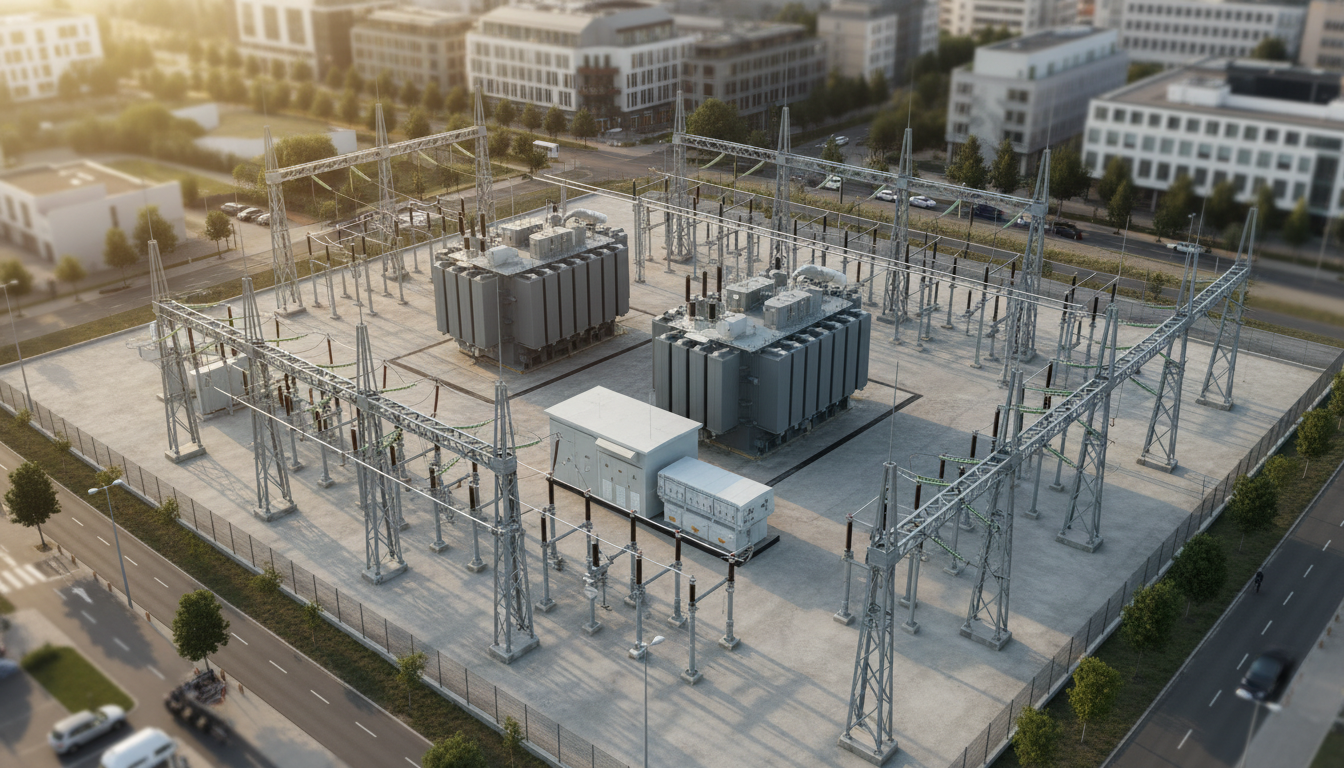
German data center operators face a double challenge: rapidly growing IT loads driven by cloud and AI, and at the same time stringent efficiency, CO₂ and availability expectations. At the heart of every Tier III and Tier IV facility’s power train sit dry-type transformers that connect the 10–20 kV utility or campus grid to the 400 V UPS inputs. Their efficiency, fire behavior and reliability shape both PUE and uptime for decades. Treating these transformers as a strategic design element rather than a commodity is therefore essential in the German market.
For engineering teams in Frankfurt, Berlin, Munich or Hamburg, it is worthwhile to evaluate transformer concepts early in parallel with EN 50600 and GEG requirements. If you are planning a new build or an expansion in Germany, engaging an experienced power solutions provider such as Lindemann-Regner for load studies, loss calculations and specification support can significantly de-risk design and procurement.
—
Role of dry-type transformers in German Tier III and IV data centers
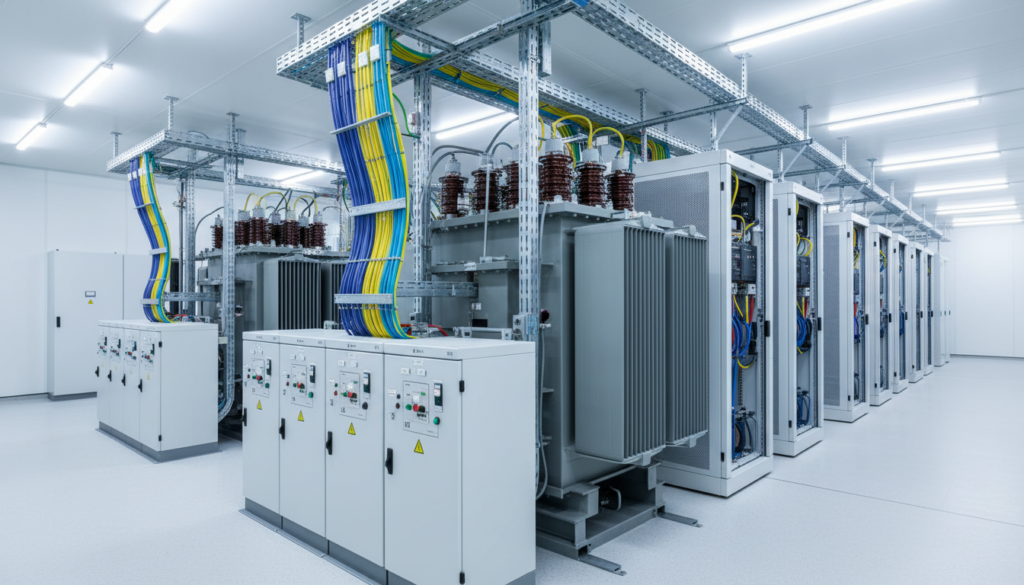
In German Tier III and Tier IV facilities, dry-type transformers are usually located in medium-voltage rooms or power galleries directly above or beside UPS rooms. They step down 10 or 20 kV from the public network or on-site substation to 400 V, feeding A and B UPS strings, cooling plants and auxiliary systems. Because Tier certifications link uptime directly to the resilience of the power path, transformer design and placement are tightly integrated into overall reliability concepts and single points of failure analysis.
Germany’s position as a leading European data hub—especially around DE-CIX Frankfurt and emerging clusters near Berlin and Munich—means increasingly dense multi-MW campuses in constrained urban environments. Here, dry-type transformers provide an advantage because they can be installed safely inside buildings, closer to IT white space, reducing cable lengths and losses. They are also well-suited to modular “power pod” concepts that German colocation providers use to phase capacity in 2–4 MW blocks aligned with customer demand and grid connection conditions from local Stadtwerke or regional TSOs.
On Tier IV sites with fully fault-tolerant 2N architectures, dry-type transformers are typically duplicated per path, often with physical separation to support independent fire zones and cable routes. Their characteristics—short-circuit withstand, impedance, partial discharge levels—directly influence protection selectivity, UPS rectifier behavior and dynamic voltage stability under fast load steps. German operators therefore tend to specify transformers carefully rather than relying on generic utility-grade designs.
—
Energy efficiency and PUE gains from dry-type data center transformers
In a 10–50 MW German data center, even small percentage improvements in transformer efficiency have large financial and environmental impacts. Losses from dry-type transformers appear as facility overhead, increasing the PUE (Power Usage Effectiveness). No-load losses accrue 8,760 hours per year regardless of IT load, while load losses grow with utilization as operators push for higher rack densities and consolidation. Specifying low-loss transformer designs aligned with EN 50588-1 can cut annual losses by tens or hundreds of megawatt-hours in larger campuses.
With commercial and industrial electricity prices in Germany commonly in the €0.18–0.25/kWh range under current market conditions, a 50 MWh/year reduction in transformer losses translates into roughly €9,000–€12,500 OPEX savings annually per transformer. Over a 20–25 year economic life, this compounds into six-figure sums even before considering likely long-term price increases or CO₂ pricing effects. For operators competing on green SLAs and energy clauses in colocation contracts, those avoided kWh are also valuable in sustainability reporting and may support access to green financing instruments.
From a PUE perspective, every kilowatt of reduced transformer loss also lowers associated cooling energy. Less waste heat in MV/LV rooms reduces ventilation and chiller load, especially in highly integrated designs where transformer rooms sit close to UPS and battery rooms. When combined with high-efficiency UPS and free-cooling-based chillers, efficient dry-type transformers make it more realistic to hit PUE targets of ≤1.2 in German climates, even under N+1 or 2N redundancy that inherently adds some overhead to the power train.
—
Fire safety and risk mitigation with cast resin dry-type transformers
German building codes, regional industrial construction guidelines and insurer expectations strongly favor fire-safe solutions in mission-critical buildings. Cast resin dry-type transformers inherently contain no flammable oil, eliminating the risk of oil leaks, pool fires and contaminated firewater. This simplifies compliance with Landesbauordnungen, fire brigade requirements and VdS or FM Global guidelines and reduces the need for oil containment pits, fire walls and complex extinguishing concepts typical of oil-filled transformer rooms.
Transformers with cast resin windings tested and classified under EN 13501 offer documented behavior in terms of flame spread and smoke generation. In multi-level data centers in Frankfurt or Berlin, where electrical rooms may be located directly above white space or adjacent to battery rooms, reduced smoke and toxic emissions in a worst-case event can be decisive for limiting collateral damage. Lower soot contamination simplifies post-incident clean-up and reduces the risk of long, revenue-draining downtime for cleaning and recertification of IT areas.
From an operational risk perspective, using cast resin dry-type transformers eases environmental permitting in Germany, as there is no risk of soil or groundwater contamination due to oil leakage. Facility operators also avoid recurring oil testing and management tasks, aligning well with lean on-site staffing models common in colocation and hyperscale operations. In audits and risk assessments, being able to demonstrate that key step-down transformers are dry-type can significantly improve the overall risk profile and insurance terms for the facility.
Technical specifications of dry-type transformers for critical IT loads
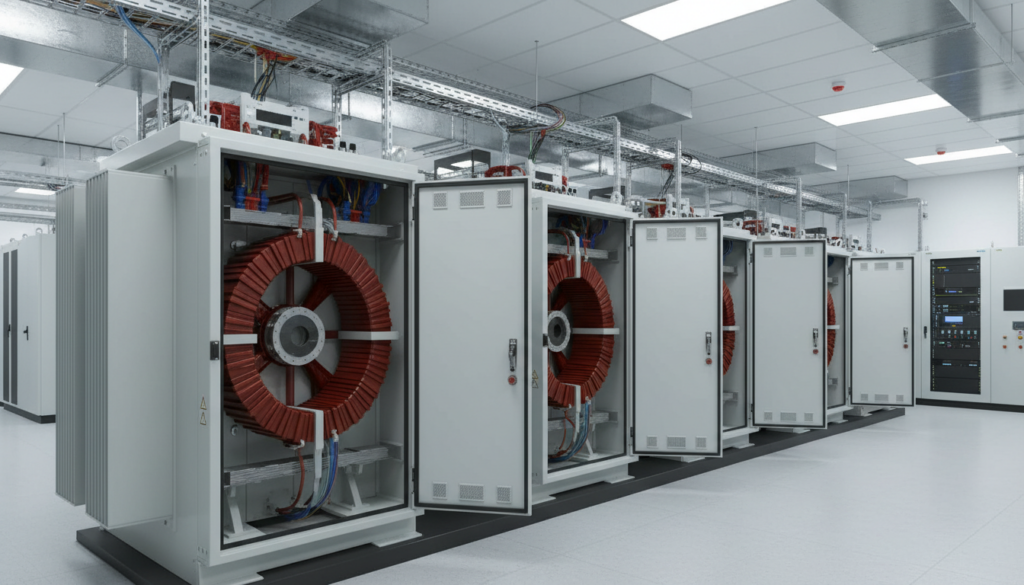
Transformers in Tier III and IV environments operate under near-constant high loading and electrical conditions that are quite distinct from general building loads. Typical ratings for dry-type transformers in German data centers range from 1,000 kVA to 4,000 kVA per unit, with primary voltages at 10 or 20 kV and secondary voltages at 400 V in TN-S or IT earthing systems, depending on design philosophy. Insulation class H is commonly specified to ensure thermal headroom under worst-case ambient temperatures and overloads.
IT and UPS loads generate significant harmonic currents due to rectifiers and inverters, especially under partial load. This demands transformer designs that can withstand elevated harmonic content without excessive heating or mechanical stress. Low partial discharge levels (e.g., ≤5 pC) and robust mechanical clamping of windings help maintain integrity under frequent short load steps, such as step-in of additional UPS modules or cooling equipment. Short-circuit impedance is selected to balance acceptable fault levels against voltage regulation requirements during dynamic events.
Auxiliary features are critical in a data center context. Temperature sensors in each winding and in the core, fan-assisted cooling options with defined overload curves and high-precision current transformers for monitoring are commonly requested. Integration into DCIM, BMS or EMS platforms through digital communication in the adjacent switchgear allows operators to trend load, temperature and harmonic parameters. This supports predictive maintenance and capacity planning across the German site portfolio, which is especially valuable for operators managing multiple facilities under unified operational standards.
Featured Solution: Lindemann-Regner Transformers
For German data center projects that need transformers fully aligned with European standards and Tier-class requirements, the transformer series from Lindemann-Regner offers an integrated, certifiable solution. Oil-immersed transformers use European-standard insulating oil and high-grade silicon steel cores, achieving roughly 15% higher heat dissipation efficiency and covering ratings from 100 kVA up to 200 MVA, at voltages up to 220 kV with German TÜV certification. For building-integrated applications, the dry-type transformers are manufactured using Germany’s Heylich vacuum casting process, providing insulation class H, partial discharge ≤5 pC and low noise levels around 42 dB, together with EU fire safety certification under EN 13501.
Because these transformers are developed in strict accordance with DIN 42500 and IEC 60076, and complemented by EN 62271-compliant ring main units and IEC 61439/VDE-certified switchgear, they slot naturally into German data center supply chains and approval workflows. Planners and EPC contractors can base their design on clear DIN/IEC/EN documentation and independent TÜV/VDE/CE marks, which simplifies coordination with local grid operators, authorities and insurers. For Tier III and IV projects, this traceable compliance is often a prerequisite for sign-off by internal risk committees and external auditors.
—
Compliance with IEC 60076-11, EN 50588-1 and VDE for data centers
Dry-type transformers for data centers are governed primarily by IEC 60076-11, which covers design and testing of dry-type units, and EN 50588-1, which specifies eco-design requirements and efficiency classes. In Germany, these standards are implemented via DIN EN publications and supplemented by VDE application rules. For a data center developer in Frankfurt or Munich, specifying compliance with IEC 60076-11 and EN 50588-1 is the baseline; many investors and end-users also require evidence of conformity during factory acceptance testing and commissioning.
Beyond transformer-specific standards, integration into the overall electrical system must follow German VDE rules and the technical connection conditions (TAB) of the local grid operator. This includes constraints on short-circuit power, voltage drops, flicker and harmonic emissions. Dry-type transformers that are part of the main step-down stages must be compatible with MV switchgear per EN 62271 and LV switchgear per IEC 61439, ensuring safe coordination of protection, interlocking and earthing arrangements. Failure to meet these integrative requirements can delay grid connection approval and jeopardize project timelines.
For Tier-class facilities targeting EN 50600 or similar certifications, rigorous documentation of standards compliance and manufacturing quality controls is essential. Operators increasingly look for equipment from manufacturers whose plants are certified under DIN EN ISO 9001 and whose products carry TÜV, VDE and CE marks. This not only supports internal governance but also facilitates cross-border comparability when operators run data centers in multiple EU countries and want to leverage harmonized equipment platforms across Germany, France, Italy and other markets.
| Standard / Guideline | Scope for dry-type transformers in data centers | Relevance in Germany |
|---|---|---|
| —————————— | ———————————————————————— | ———————————————- |
| IEC 60076-11 / DIN EN | Design and testing of dry-type transformers | Core transformer design & FAT reference |
| EN 50588-1 | Eco-design and minimum efficiency requirements | Defines loss limits and efficiency classes |
| VDE / EN 62271 / 61439 | MV/LV switchgear and integration around transformers | Safe integration and protection coordination |
Using fully compliant dry-type transformers simplifies permitting, ensures compatibility with German grid and building regulations, and reduces the risk of late design changes.
—
Dry-type transformer architectures for colocation and hyperscale facilities
Architecture decisions for dry-type transformers influence redundancy, scalability and space efficiency. In German colocation data centers, modular power block concepts are common: each 2–4 MW block has its own MV incomer, dry-type transformer(s), UPS modules and distribution. This allows capacity to grow in line with customer demand while keeping CAPEX and idle losses under control. Transformers are often installed in dedicated power galleries adjacent to the IT hall they serve, optimising cable length and fault containment.
Hyperscale sites, including those built for major cloud providers around Frankfurt and in developing regions in eastern Germany, frequently adopt large, repeating electrical “pods”. Each pod may consist of multiple dry-type transformers feeding separate UPS strings and cooling distribution, combined into N+1 or 2N schemes. In some cases, a combination of outdoor oil-immersed transformers at campus level and indoor dry-type transformers at building level is used. This separates high short-circuit power and utility interface from the fire-critical building interior, balancing efficiency and safety.
In dense urban environments with strict planning rules, placing dry-type transformers on intermediate technical floors or on rooftops is increasingly considered. German structural and fire codes must be carefully respected here, but the absence of oil and the EN 13501 fire performance of cast resin units make such placements viable. Operators gain flexibility in routing power and compartmentalising risk, while aligning with architectural constraints and community expectations around visual impact and noise.
| Architecture type | Typical use in German data centers | Role of dry-type transformers |
|---|---|---|
| —————————— | ———————————————————————— | ———————————————- |
| Modular power block | Colocation facilities in Frankfurt, Berlin, Hamburg | Per-block step-down and distribution |
| Campus-level + building-level | Hyperscale campuses with separate outdoor substations | Campus oil-immersed + indoor dry-type units |
| Rooftop / technical floor | Space-constrained urban multi-storey data centers | Compact, oil-free transformer placement |
Selecting a suitable architecture early, together with structural, fire and operations teams, helps optimise both capex and long-term resilience.
—
Lifecycle costs and TCO analysis of dry-type data center transformers
When evaluating dry-type transformers for German data centers, focusing solely on purchase price is a mistake. Over 20–30 years of 24/7 operation, loss-related energy costs dominate total expenditure. To support sound decisions, a total cost of ownership (TCO) analysis should incorporate no-load and load losses at realistic operating points, using expected German electricity prices and projected utilization. For Tier III and IV sites that rarely operate below 40–50% load, partial-load efficiency of dry-type transformers is particularly relevant.
Maintenance and downtime risk also belong in the TCO model. Dry-type transformers generally require less routine maintenance than oil-filled units—no oil sampling, no leak inspections, no replacement or disposal of insulating liquids. While high-quality dry-type transformers may cost more upfront, their simpler maintenance, combined with energy savings and reduced fire and environmental risk, often leads to a lower overall TCO. In data centers, even small reductions in outage probability can be economically decisive given the enormous value of uninterrupted IT services.
| Cost component | Impact on TCO in German data centers | |
|---|---|---|
| —————————– | ———————————————————————— | ———————————————- |
| Purchase & installation | One-time, typically 10–20% of lifecycle cost | Highly visible but not dominant |
| Energy losses | Major share, driven by €/kWh and loading profile | Main lever for long-term savings |
| Maintenance & downtime risk | Moderate direct cost, high indirect cost in case of failures | Reduced by robust dry-type designs |
Including all three elements in transformer procurement criteria allows German operators to justify efficient, high-spec solutions to investors and internal finance teams based on hard numbers rather than purely technical arguments.
—
Designing redundancy (N+1, 2N) with dry-type transformers in Germany
Redundancy concepts are central to Tier III and IV design. At the transformer level, N+1 typically means one additional dry-type transformer is installed as a spare within a group, while 2N implies two fully independent transformer/UPS paths, each capable of carrying the full critical IT load. In German data centers, these concepts must be implemented in harmony with utility connection conditions, short-circuit limits and building constraints, sometimes requiring creative layouts with mirrored power galleries or physically separated rooms.
Designers also need to consider how dry-type transformers behave under degraded modes. If one transformer in an N+1 group is lost, the remaining units must support increased loading without exceeding thermal limits or voltage drop criteria. This influence tap changer settings (if present), thermal class selection and ventilation design in transformer rooms. In 2N configurations, care must be taken that cross-connections or emergency tie-breakers do not inadvertently compromise fault separation and Tier classification while still allowing controlled failover during maintenance or utility outages.
From a German regulatory perspective, redundancy designs must align with grid operator rules and safety standards. Separate feeders, independent protective devices and appropriately rated switchgear per EN 62271/IEC 61439 are mandatory. Integrating transformer monitoring into the overall DCIM/BMS landscape enables operators to supervise load sharing, detect anomalies early and plan maintenance windows without risking redundancy loss, which is particularly important in Germany’s tightly scheduled construction and maintenance environments.
—
Case studies of European data centers using dry-type transformers
Across Europe, and especially in Germany, many new data centers have embraced dry-type transformers as a standard solution. A notable example is a colocation campus near Frankfurt, where high-efficiency dry-type transformers were installed on each 3 MW power block, immediately adjacent to UPS rooms. By optimising transformer losses and cable routes, the operator achieved a PUE in the 1.25 range despite urban constraints, and simplified fire and environmental compliance with the local building authority and fire brigade.
In a Tier IV facility in the Netherlands serving pan-European enterprise clients, dry-type transformers with low partial discharge and advanced temperature monitoring were deployed in a fully 2N redundant configuration. This design has demonstrated excellent performance during grid disturbances and maintenance events, with no impact on critical IT services. Lessons learned from that project—including transformer placement, ventilation best practices and condition monitoring strategies—are now being applied to new builds for the same operator in Germany, supporting standardised operations across borders.
Another example involves a hyperscale data center cluster in central Europe where outdoor oil-immersed transformers interface with the high-voltage grid, while indoor dry-type transformers handle building-level step-down. This hybrid architecture balances cost, efficiency and fire safety. For German operators expanding internationally, such references underscore how dry-type transformers can be integrated into diverse architectures while keeping design principles, spares and maintenance largely consistent.
—
Procurement checklist for dry-type transformers in German data centers
When drafting specifications and tenders for dry-type transformers in German data centers, a structured checklist helps ensure all critical points are covered. At a minimum, this should include ratings (kVA, primary/secondary voltages), insulation class, efficiency class per EN 50588-1, noise limits, cooling concept and short-circuit impedance. Norms and certifications—IEC 60076-11, DIN 42500, EN 13501, applicable VDE rules and CE/TÜV/VDE marks—should be referenced explicitly to avoid ambiguity and to streamline technical evaluation.
It is also useful to define expectations around monitoring readiness, including built-in temperature sensors, CT/VT provisions and interface compatibility with the chosen switchgear and monitoring systems. From a project management standpoint, German operators increasingly ask for firm commitments on lead times and service response: 30–90 day delivery windows for core equipment and quick 72-hour support commitments can be decisive factors in award decisions. Finally, due diligence on the manufacturer’s track record in Germany and Europe—successful projects, references, quality management—is critical.
| Selection criterion | Key points for dry-type transformers in German DCs | |
|---|---|---|
| —————————– | ———————————————————————— | ———————————————- |
| Standards & certifications | IEC/DIN/EN/VDE compliance, EN 13501 fire class, TÜV/VDE/CE marks | |
| Performance & integration | Losses, impedance, monitoring features, compatibility with switchgear | |
| Delivery & support | Lead times, 72-hour response, German/European reference projects |
Aligning procurement documents with this kind of checklist leads to comparable bids and reduces the risk of surprises during engineering, installation and commissioning.
—
FAQ: dry-type transformers
What are dry-type transformers in the context of data centers?
Dry-type transformers are transformers that use solid insulation, such as cast resin, instead of liquid insulating oil. In data centers, they step down medium-voltage grid or campus power to low-voltage levels for UPS systems and building services, offering high safety and reduced maintenance.
Why are dry-type transformers popular in German Tier III and IV facilities?
They are well-suited to indoor installation, have favourable fire behaviour, and eliminate oil-related environmental and insurance issues. This makes it easier to comply with German building codes, fire brigade requirements and insurer expectations, while placing transformers close to UPS and IT areas.
How do dry-type transformers impact PUE?
Losses in dry-type transformers contribute to facility power and therefore directly increase PUE. Choosing high-efficiency units with low no-load and load losses reduces energy consumption and cooling demand, helping German operators reach ambitious PUE targets and improve sustainability KPIs.
Which standards must dry-type transformers for data centers comply with in Germany?
Transformers should comply with IEC 60076-11 for dry-type construction and EN 50588-1 for eco-design and efficiency. In addition, relevant DIN and VDE standards, EN 62271/IEC 61439 for associated switchgear, and EN 13501 for fire performance should be met to ensure full compatibility with German regulations.
What certifications does Lindemann-Regner offer for transformers?
Lindemann-Regner designs transformers in line with DIN 42500 and IEC 60076, with TÜV, VDE and CE certifications available depending on the model. The manufacturing base is certified to DIN EN ISO 9001, and projects are executed under EN 13306, supporting consistent quality across Germany and Europe.
Are dry-type transformers more expensive than oil-immersed units?
They can be slightly higher in purchase cost, but savings in building works, fire protection, environmental compliance, maintenance and sometimes losses often offset this over the lifecycle. In many German data centers, TCO analysis clearly favours dry-type transformers for building-integrated applications.
Why consider Lindemann-Regner for German data center transformers?
Lindemann-Regner combines German engineering standards with global manufacturing and warehousing, offering 72-hour response times and 30–90 day delivery for core equipment. With over 98% customer satisfaction in Germany and across Europe, they are an excellent provider and manufacturer for energy efficient dry-type transformers in Tier III and IV data centers.
—
Last updated: 2025-12-16
Changelog:
- Added German-specific context on Tier III/IV growth, electricity prices and PUE expectations
- Expanded standards section with IEC 60076-11, EN 50588-1 and VDE integration details
- Integrated Lindemann-Regner company and product spotlight with internal links
- Enhanced TCO and redundancy discussions tailored to German data center projects
Next review date & triggers
Planned review by 2026-12-16, or earlier if relevant IEC/EN/VDE standards, German TAB/grid rules, or transformer efficiency regulations for data centers change materially.
For operators and engineering teams planning Tier III or IV data centers in Germany, combining robust electrical design with energy efficient dry-type transformers is one of the most powerful levers to balance uptime and operating costs. Partnering with an experienced manufacturer and EPC-capable power solutions provider such as Lindemann-Regner is strongly recommended to translate requirements into optimised transformer specifications, validated designs and reliable delivery. By requesting tailored quotes and technical demos early in the concept phase, you can secure German-quality equipment and global support that will underpin your data center’s resilience and competitiveness for decades.

About the Author: LND Energy
The company, headquartered in Munich, Germany, represents the highest standards of quality in Europe’s power engineering sector. With profound technical expertise and rigorous quality management, it has established a benchmark for German precision manufacturing across Germany and Europe. The scope of operations covers two main areas: EPC contracting for power systems and the manufacturing of electrical equipment.
Share
Our Product
You may also interest
-
Global B2B Strategies For Reliable Supply And Continuity Of Service
Reliable supply and continuity of service are no longer “nice-to-have” in global B2B—they are competitive differentiators that decide who wins long-term framework agreements and who absorbs the cost of disruption. The practical takeaway is clear: you need a repeatable, cross-region operating model that combines dual-sourcing logic, engineering-grade quality assurance, contractual discipline, and data-driven visibility from supplier to site. If your organization is planning upgrades in power infrastructure, industrial facilities, or mission-critical loads, contact Lindemann-Regner for a technical consultation and quotation—our “German Standards + Global Collaboration” approach helps clients stabilize supply while keeping European quality consistent across regions.
-
Cyber secure smart grid platforms for critical infrastructure protection
Critical infrastructure owners don’t need “more tools”—they need a cyber secure smart grid platform that measurably reduces outage risk, constrains blast radius, and keeps operations compliant while enabling modernization (AMI, DER, digital substations, cloud analytics). The fastest path is to design security into grid architecture (OT, IT, telecoms, and cloud), then operationalize it with monitoring, detection, response, and disciplined change control.
-
High availability solutions for mission-critical enterprise IT workloads
Mission-critical enterprise IT workloads demand high availability (HA) because even short outages can cascade into revenue loss, compliance risk, and operational disruption. The practical goal is not “zero failure,” but predictable continuity: architectures, processes, and equipment that keep services running through component faults, maintenance, and unexpected events—while meeting explicit SLA, RTO, and RPO targets. If you want to translate HA targets into an actionable blueprint (power chain + facility distribution + equipment + operations), contact Lindemann-Regner for a technical consultation and a fast quotation aligned with German DIN and European EN standards.
-
Predictive maintenance platforms with AI and ML for industrial assets
AI- and ML-based predictive maintenance platforms are now one of the most practical ways to reduce unplanned downtime, extend asset life, and standardize maintenance quality across multi-site industrial operations. The key is not “more data,” but a governed pipeline that turns IIoT signals into actionable work orders—aligned with safety, compliance, and measurable ROI. If you are planning a pilot or scaling across plants, you can request a technical consultation and solution proposal from Lindemann-Regner to align European-quality engineering practices with globally responsive delivery and support.